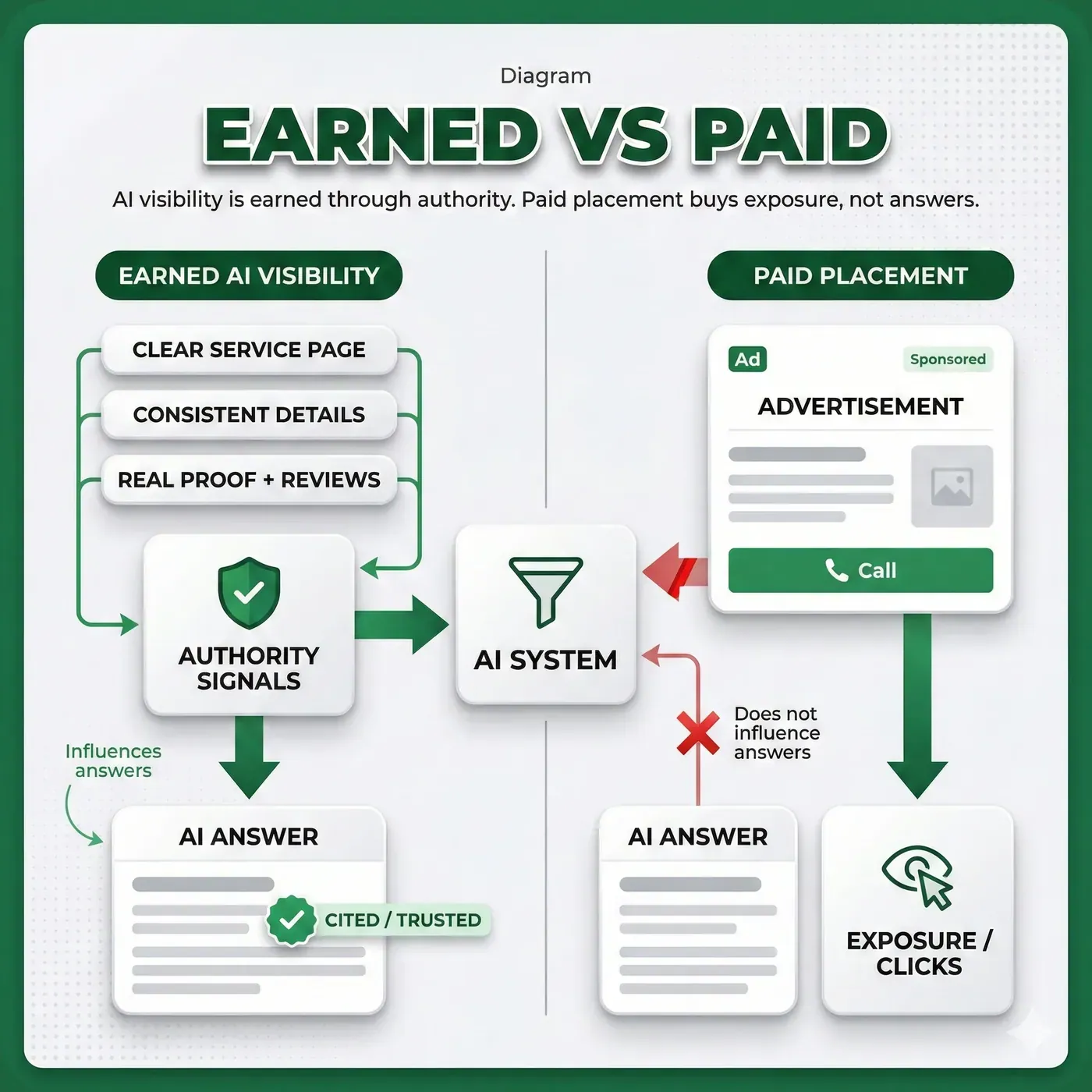
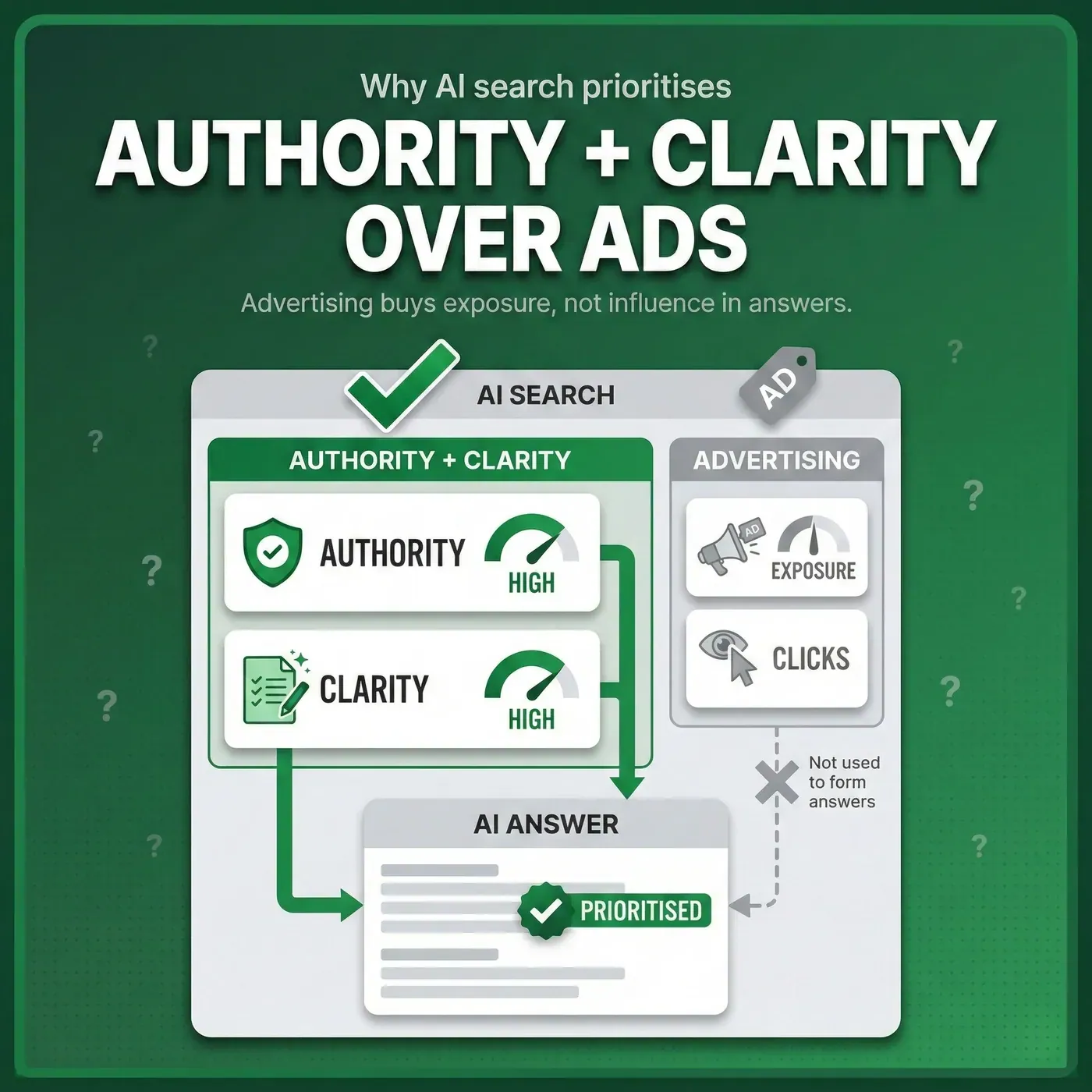
In AI search, authority, clarity, consistency, and corroboration matter more than ads. Advertising does not affect how AI systems judge, choose, or summarise information. Ads only buy exposure outside the answer process.
Why ads are mistaken for influence
Ads now appear inside AI tools, so people assume money brings leverage. That belief comes from search and social ads, where paid spots sit close to discovery.
AI search works differently.
AI systems protect trust first. They keep ads away from answers on purpose. This separation is not visual design. It is a safety rule.
How AI search decides what to show
AI search does not sort pages by rank. It selects information it can explain with confidence.
In practice, AI systems look at a short list of signals:
- Clarity of meaning
- Consistency across sources
- External corroboration
- Readable structure
- Safety context
Ads are not part of this list.
Clarity matters more than reach
AI systems surface content that explains things plainly.
They look for answers to basic questions:
- What is this
- Who is it for
- Where does it apply
- What does it not claim
Pages that rely on hype or persuasion are harder to summarise. Clear explanations win more often than clever copy.
Consistency builds confidence
AI systems avoid contradiction.
If your website, profiles, and third-party listings say different things, the system cannot summarise you safely. Inconsistent entities are skipped.
Consistency across pages matters more than how often you publish.
Corroboration outweighs claims
AI systems prefer information that appears in more than one place.
They trust alignment with:
- Industry publications
- Institutional definitions
- Regulatory guidance
- Established media
Claims that exist only on your own site carry less weight. Ads do not change this.
Structure helps AI extract meaning
AI systems rely on structure to find answers.
Content performs better when it uses:
- Direct answers
- Clear headings
- Simple comparisons
- Defined scope
This type of content may look plain to marketers, but it works well for summarisation.
Safety gates override all other signals
Topics tied to health, law, or money face higher checks. AI systems require strong confidence before surfacing advice in these areas.
This follows long-standing safety rules used in search systems. Ads do not bypass these checks.
What ads can do and what they cannot
Ads can increase awareness and brand recall. They can support launches and short campaigns.
Ads cannot improve AI visibility. They cannot shape answers. They cannot replace authority or pass safety checks.
OpenAI has stated that ads do not affect response generation. Google has stated the same separation for search ads.
Authority signals versus ad signals
Clear definitions influence AI answers and grow stronger over time.
Consistent entity data influences AI answers and grows stronger over time.
External citations influence AI answers and grow stronger over time.
Structured content influences AI answers and grows stronger over time.
Ad spend does not influence AI answers and stops when spend stops.
This explains why some brands appear often without ads, and others do not appear at all with ads.
Why this matters for budget choices
When teams spend on ads before building authority, results stall.
They get exposure without trust.
They get short-term views without durability.
They spend without compounding return.
AI search rewards precision, not volume.
How Valpo Agency prioritises what matters
Valpo Agency treats representation as the first job.
The work focuses on:
- Making entities clear
- Aligning facts across platforms
- Writing content that can be summarised safely
- Building authority that compounds
Ads remain optional. Authority remains required.
The rule is simple. If AI cannot explain you clearly, it will not surface you.
Frequently asked questions
Can ads ever influence AI search results
No evidence supports this. Ads stay outside answer systems.
Is authority measurable in AI search
Indirectly. It shows up through accurate summaries and repeated mentions over time.
Should businesses stop advertising
No. They should stop asking ads to do the work of authority.