Seasonal slowdowns hurt some home service businesses unevenly. The businesses that get hurt most rely on one-time jobs, peak-season ads, and a narrow set of services. The businesses that stay steady build repeat revenue, sell off-season work, and keep a simple plan for staff and cash.
The gap you see in the same town
Two companies can serve the same neighborhoods and still live in different worlds.
Picture two HVAC shops in one mid-sized city.
Both have 10 plus years in business.
Both sit around 4.6 to 4.8 stars.
Both run 6 to 8 techs in summer.
Then winter hits.
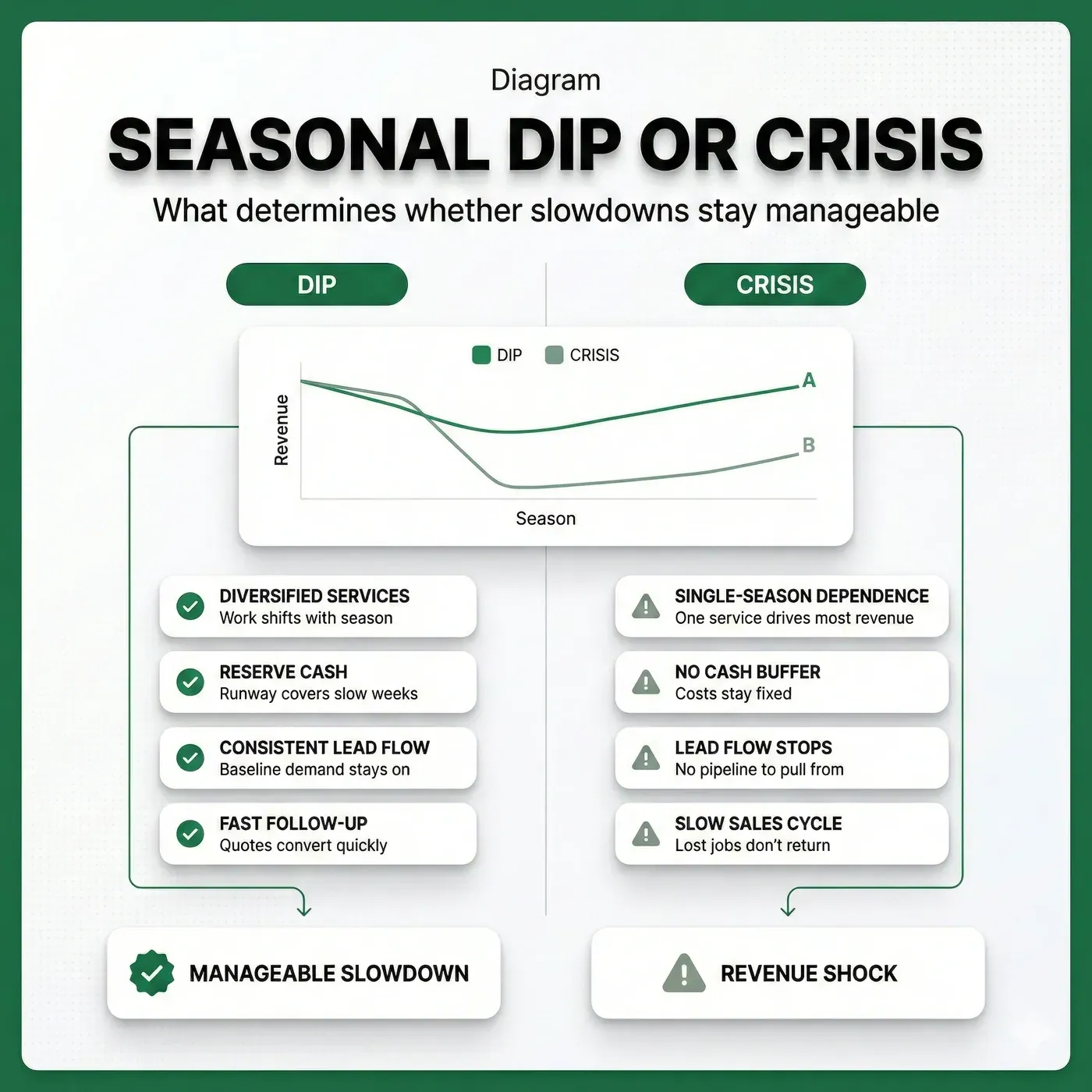
One shop drops hard. Revenue falls 50 to 70 percent from peak months. They cut ads, cut hours, and hope phones ring again in spring.
The other shop drops a little. Revenue dips 10 to 25 percent. They keep staff, keep marketing, and keep work flowing through planned services.
Same market. Same weather. Different outcome.
What seasonality really is
Seasonality is not the problem. Every home service line has natural swings.
Heat pumps peak in summer.
Furnace work rises in fall.
Landscaping lives and dies on daylight and soil.
Roofing slows when storms and cold make installs harder.
The problem starts when a business has no buffer. Then a normal dip turns into a cash crisis.
The six reasons some businesses get crushed
Transaction-only customer relationships
A one-time job ends the relationship. The customer calls again only when something breaks.
That model depends on emergencies and weather triggers.
A relationship model keeps the customer active year-round. It creates planned work, not just panic calls.
You will see this difference fast:
Transaction model
- Big peaks, big drops
- High churn
- Low repeat revenue
Relationship model
- Smaller peaks, smaller drops
- Higher repeat rate
- More planned work
Marketing that stops when it gets slow
A lot of owners cut marketing in the months they need it most.
They spend heavy when phones already ring.
They shut it off when calls slow down.
That choice deepens the dip.
Off-season marketing often costs less. Competition is lower. It also gives people time to plan work before peak season returns.
A service list tied to one season
Some services are seasonal by nature. That is fine. The risk comes from concentration.
If 80 percent of revenue comes from one season, the business will feel every weather swing.
The fix is simple on paper. Add a second lane of work that sells when the first lane slows.
Examples that show up in real shops:
HVAC
Furnace tune-ups, air quality, duct work, smart thermostats
Landscaping
Hardscape repairs, outdoor lighting, drainage, leaf cleanup
Roofing
Gutters, attic ventilation, insulation checks, leak tracing
Plumbing
Water heater checks, fixture upgrades, water quality installs
Fixed overhead that does not shrink in slow months
Rent, trucks, insurance, software, and payroll do not care about the weather.
A shop can make strong margins in summer and still lose money in winter.
You can spot this trap with one simple check.
Take your slowest month revenue.
Subtract your fixed overhead for that month.
If the number is negative, you are funding winter with summer.
That is not fatal, but it needs a plan.
Selling work as optional instead of necessary
Homeowners delay optional projects first.
They postpone upgrades during holidays.
They pause big jobs when money feels tight.
They wait for better weather.
Positioning changes this.
A message like “upgrade your system” feels optional.
A message like “prevent a breakdown and reduce winter bills” feels urgent.
Same service. Different frame. Different timing.
Rigid staffing and weak planning
Some shops staff for peak season and then panic in slow season.
Layoffs in winter create turnover.
Hiring in spring creates training gaps.
Training gaps create bad reviews.
A flexible plan keeps a core team stable and adds capacity around it.
Common methods:
- A core crew year-round
- Seasonal hires for peak months
- A small contractor bench for overflow
- Cross-training so techs can shift into off-season services
What steady businesses do instead
They build recurring revenue
Maintenance plans are the classic example. They work in many trades.
They create scheduled visits during slow months.
They keep the business in front of past customers.
They reduce emergency-only dependence.
A simple target that many owners can picture:
100 members at $199 per year equals $19,900 recurring revenue.
200 members equals $39,800.
That helps cover overhead when the weather goes quiet.
They sell counter-season work
They pick one or two services that fit their skills and tools. They sell those services hard in the months that used to be dead.
They also keep the offers plain:
- Tune-up packages
- Safety checks
- Preventive inspections
- Small upgrades with clear outcomes
They keep talking to customers in the off-season
Most competitors go silent.
Steady shops stay present with simple messages:
- Season prep reminders
- Maintenance schedules
- Small offers tied to real problems
- Short tips that match the weather
This keeps them top of mind when the next need appears.
They plan cash like a seasonal business
Peak profits are not “extra.” They are fuel for the next dip.
A basic rule that keeps owners out of trouble:
Set aside a fixed share of peak profit each month into a reserve.
Use the reserve to cover slow months without panic cuts.
A practical target is 3 months of slow-season fixed overhead in reserve.
They use pricing to shift demand
They do not slash prices out of fear. They use incentives to move timing.
Examples:
- Early booking discounts for spring work
- Flexible scheduling discounts in slower weeks
- Bundled maintenance visits across seasons
The goal is a smoother workload, not cheap work.
A simple 12-month plan to reduce the pain
Months 1 to 3
Pull last year’s monthly revenue.
Find your peak month and your lowest month.
Calculate the drop.
Then answer these:
- What percent of jobs are repeat customers
- What percent of revenue is planned work
- Which services sell in your slow months
- What fixed costs stay the same all year
Months 4 to 6
Launch one recurring offer.
Pick one off-season service.
Train staff and build a basic script for selling it.
Months 7 to 9
Run an off-season message plan.
Email, text, or postcards all work.
Keep it simple and consistent.
Track:
- Calls by service type
- Booked jobs in slow months
- Plan sign-ups
- Opt-outs and complaints for SMS
Months 10 to 12
Review what worked.
Double down on the one offer that sold best.
Set a reserve target for the next year.
Decide staffing moves before peak season starts.
What to measure so you know it is working
Track these numbers monthly:
Peak-to-trough ratio
Example: $180k peak and $60k low is 3x. Aim to bring it down.
Off-season revenue as a percent of peak
Aim to raise this each year.
Recurring revenue percent
Aim for 20 to 40 percent over time in many trades.
Staff retention through slow season
High retention saves money and protects quality.