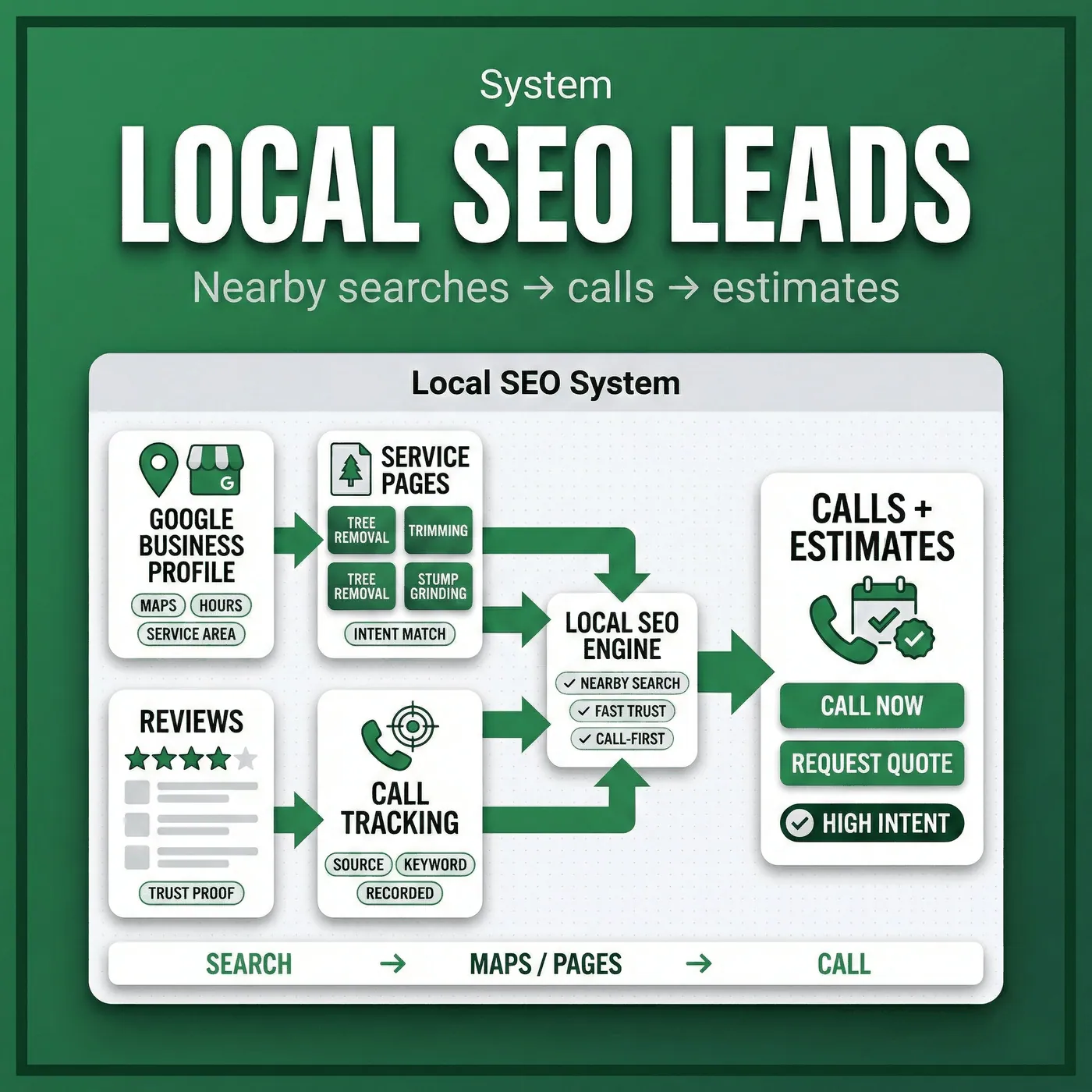
Local SEO increases tree service leads when you improve three things Google says local results are based on: relevance, distance, and prominence. In practical terms, that means building service pages that precisely match what people search, tightening and completing your Google Business Profile, and increasing trust signals like reviews and citations so Google can confidently show you and homeowners can confidently call you.
Table of contents
- What local SEO actually does for tree services in 2026
- The three local ranking factors you can influence
- Your Google Business Profile as a lead engine
- Service pages that rank and convert
- Location coverage without spam
- Reviews that increase both trust and local visibility
- Local citations and consistency
- Local links and community authority
- Technical SEO that supports local lead conversion
- Tracking what actually drives inquiries
- A 30-day local SEO lead plan
- FAQs
1. What local SEO actually does for tree services in 2026
Local SEO is not just “ranking on Google.” For a tree service business, local SEO is a demand-capture system. It helps your business show up when someone nearby searches for a service you offer, then it helps convert that visibility into calls and estimate requests.
Tree service demand is highly intent-driven. Homeowners do not browse tree services casually the way they might browse patios or kitchen styles. They search because something happened or something is about to happen:
- a leaning tree after a storm
- branches over a roof
- a dead tree near a driveway
- a property sale or inspection issue
- seasonal trimming and maintenance
Local SEO works because it matches your business to these moments. Your job is to make that match easy for both Google and the homeowner.
2. The three local ranking factors you can influence
Google states that local results are based primarily on relevance, distance, and prominence.
You cannot control distance, but you can control how well your business is interpreted in context of distance, and you can influence relevance and prominence strongly.
Relevance
Relevance is about how well your listing and your website match the search.
For tree services, relevance problems usually look like this:
- Your Business Profile categories are too broad or wrong
- Your website has one generic “services” page
- Your service names do not match real search behavior (for example, “arboricultural solutions” instead of “tree removal”)
- Your content does not answer the questions people actually ask before hiring
Distance
Distance is based on the searcher’s location and the location of your business.
You cannot hack distance. What you can do is:
- define a realistic service area
- build relevance for the neighborhoods and towns you actually serve
- build prominence so you are competitive when you are within range
Prominence
Prominence is about how well-known and trusted your business appears.
In the real world, prominence is built through:
- strong review volume and recency
- consistent business information across the web
- local links and mentions
- evidence of legitimacy, expertise, and activity
Local SEO is basically a structured plan to increase relevance and prominence, then capture the leads that appear inside your distance radius.
3. Your Google Business Profile as a lead engine
For many tree companies, the Google Business Profile drives more leads than the website, especially for urgent searches.
Google’s own guidance emphasizes completing business information and states you cannot pay or request better local rankings. Your advantage comes from completeness and accuracy, not tricks.
Set your profile up to match tree service buying behavior
Primary category and services
- Pick the most accurate primary category available and keep it stable.
- Add services that match real intent: tree removal, emergency tree service, stump grinding, trimming/pruning, lot clearing (if offered).
Service areas
- Define service areas that reflect your actual crew reach.
- Avoid adding far-off areas you do not serve. It creates mismatched leads and does not reliably extend rankings.
Photos that sell safety and professionalism
Tree work is a risk purchase. Upload:
- crews working with proper safety equipment
- cleanup results
- before/after shots
- equipment photos (only if they reinforce capability)
Business description
Write it like a homeowner is scanning:
- what you do
- where you do it
- what you do differently (safety, cleanup, responsiveness)
Messaging and calls
Turn on call-friendly options where available and make sure your hours match reality. Leads die when people reach voicemail or get no answer.
Use GBP posts like micro-ads
Posts do not replace ads, but they support visibility and trust. The best post topics for tree services:
- storm readiness checklist
- seasonal pruning window
- “what to do if a tree falls” guide
- recent job highlight with clear service type
Keep posts practical. “Educational” in this category is a lead generator.
4. Service pages that rank and convert
Your website is how you control relevance at scale.
A service business site should not be a brochure. It should be a set of intent-matched landing pages.
The essential service pages for tree services
Most tree companies should have separate pages for:
- Tree removal
- Emergency tree service
- Tree trimming and pruning
- Stump grinding
- Lot clearing (only if you truly offer it)
- Commercial tree services (if you want contracts)
This matters because each service has different search behavior and different hiring concerns.
The anatomy of a high-converting local service page
A tree service page that ranks and converts usually includes:
Above the fold
- One sentence that defines the service in plain language
- Your service area statement
- A phone-first call to action and a form backup
- Proof: reviews, job photos, trust badges (only truthful ones)
Scope clarity
- What is included
- What is not included
- Common scenarios and how you handle them (near structures, tight access, cleanup)
Process
Spell it out:
- site assessment
- safety and access
- cutting/removal method
- haul-off and cleanup
- final walkthrough
This removes the homeowner’s fear of unknowns.
Local proof
- photos from nearby areas
- testimonials that mention cleanliness, punctuality, safety, communication
FAQ section
Build around real pre-hire questions:
- Do you haul debris away?
- Are you insured?
- Can you work near power lines?
- Do you offer emergency response?
- How do you protect lawns and driveways?
Internal linking
Every blog post should link to a related service page, and every service page should link to adjacent services. This pushes traffic toward inquiry paths instead of letting it die on informational pages.
5. Location coverage without spam
Many local service sites make the same mistake: creating dozens of thin “City + Service” pages.
That approach can backfire because it creates low-value pages and makes your site look repetitive.
A better structure:
A “Service area hub” page
One strong page that:
- explains where you work
- lists major areas
- links to supporting location pages only where you truly have proof and relevance
A small number of real location pages
If you want location pages, make them real:
- include job photos and stories from that area
- include unique local constraints (trees common there, HOA rules, storm patterns, property types)
- include a local proof block: reviews from that area, or nearby neighborhoods
The goal is not to “mention the city.” The goal is to prove you actually operate there.
6. Reviews that increase both trust and local visibility
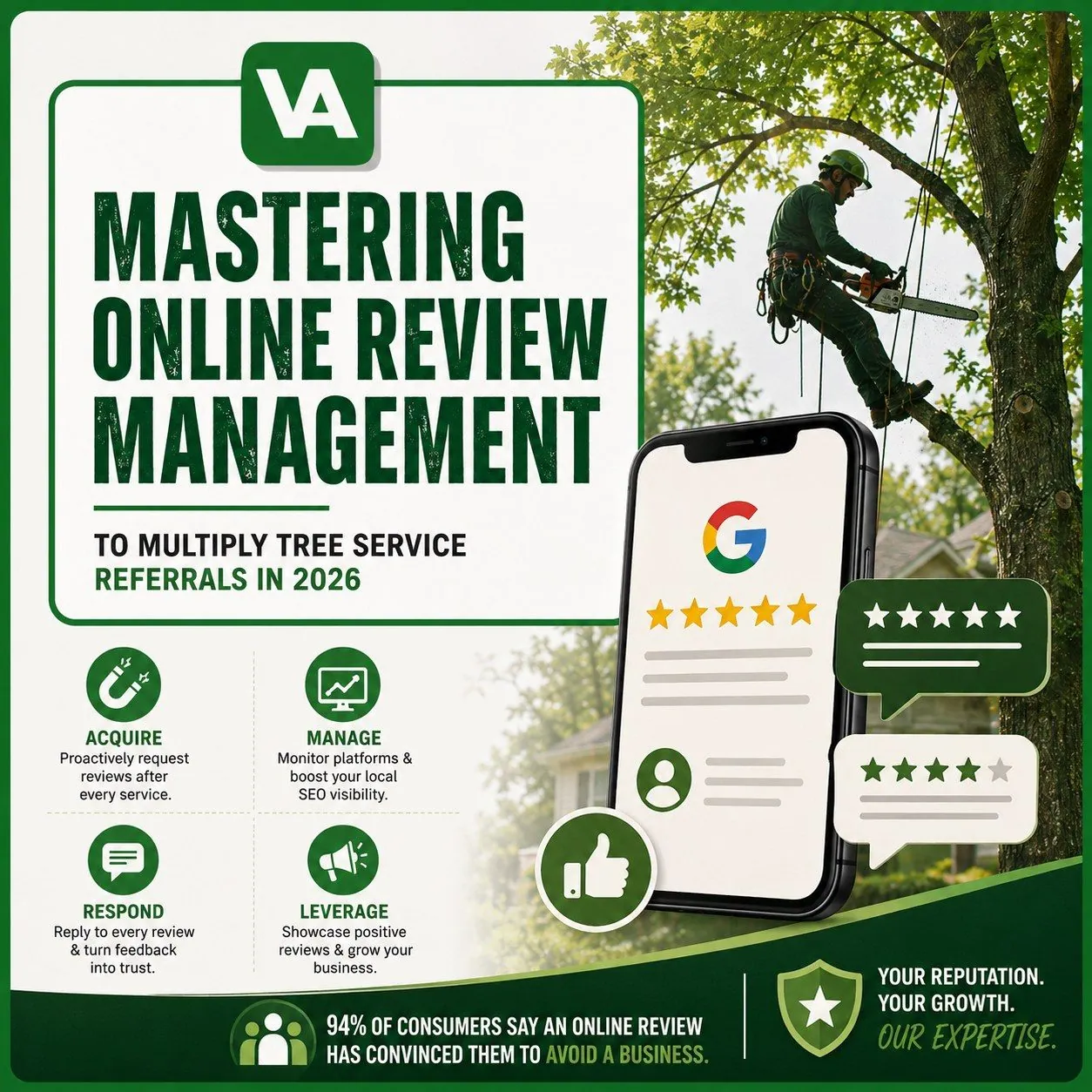
Reviews are a conversion engine. They reduce fear and speed up the decision.
Prominence is influenced by signals of trust and activity, and Google’s local ranking factors include “popularity,” which aligns with the real-world role of reviews.
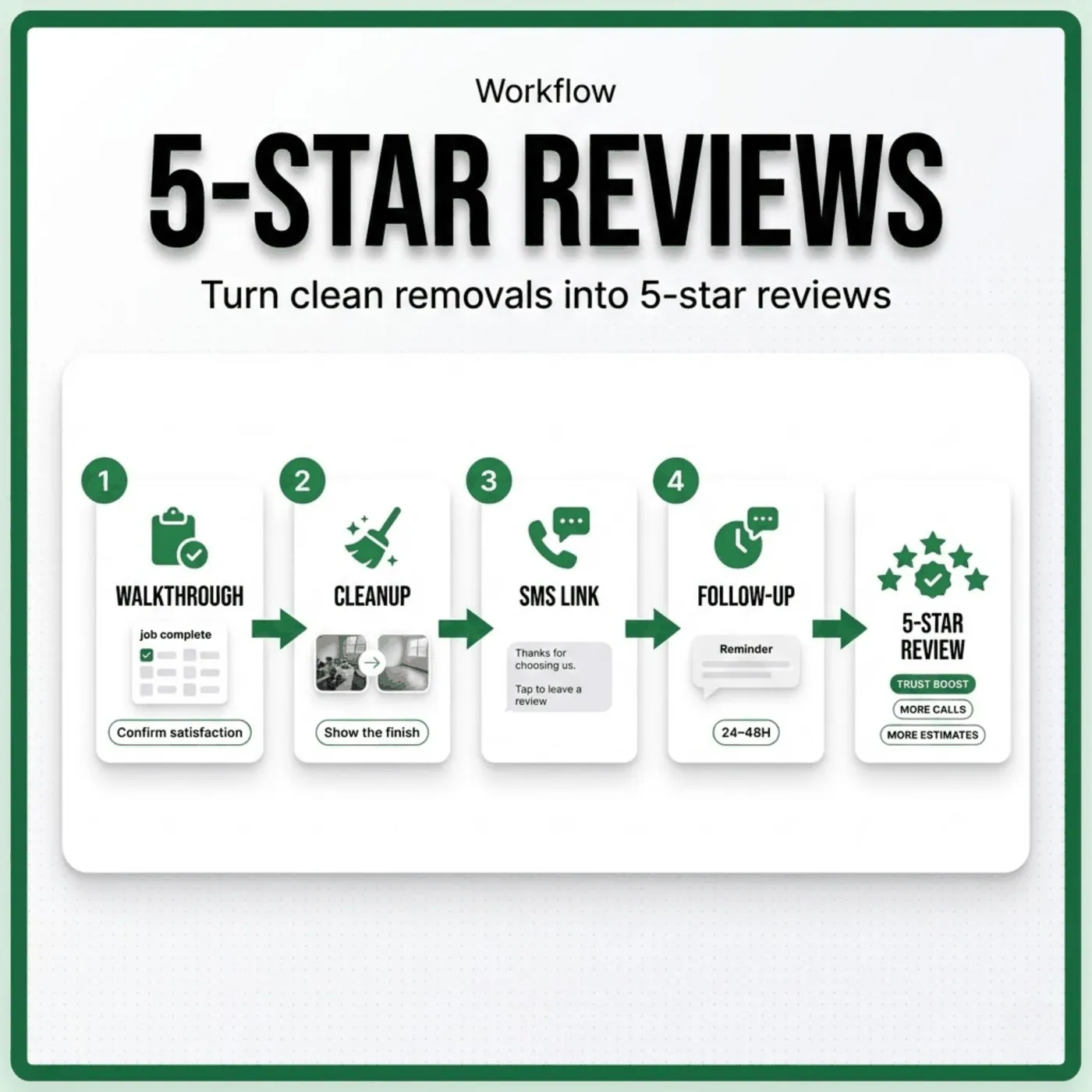
A review system that works for tree services:
- Ask after cleanup, when satisfaction is highest
- Send the link within 30 minutes
- Follow up once if they do not review
- Respond to every review
The content of reviews matters too. Homeowners want to hear about:
- safety and professionalism
- cleanup quality
- communication
- reliability and punctuality
You cannot script reviews, but you can ask customers to mention what mattered to them.
7. Local citations and consistency
Citations are any mentions of your business name, address, and phone number across the web.
The goal is not “more listings everywhere.” The goal is consistent, accurate identity signals.
Keep your NAP consistent:
- same formatting
- same phone number
- same suite number conventions
- same business name
This reduces ambiguity for Google and for homeowners.
Prioritize quality directories and local ecosystem listings:
- chamber of commerce
- local business associations
- municipal business directories (where available)
- niche contractor directories only if they are reputable in your area
8. Local links and community authority
Links are still a strong trust signal on the open web.
For local services, the most realistic link sources are:
- local sponsorships (schools, sports clubs, community events)
- partnerships (landscapers, roofers, realtors)
- local news mentions (storm response, community cleanups)
- supplier and equipment partner pages (if they publish partner directories)
The best links are not the most “SEO.” They are the most believable.
One good local mention is often more valuable than dozens of low-quality directory links.
9. Technical SEO that supports local lead conversion
Local SEO is not only content. Your site still has to load, function on mobile, and feel trustworthy.
Google’s documentation emphasizes Core Web Vitals as real-world user experience metrics and recommends achieving good CWV for a better experience, aligning with what ranking systems seek to reward.
For tree service sites, the technical priorities are:
- fast loading on mobile
- stable layout (no jumping buttons)
- tap-friendly phone and form actions
- optimized images (before/after galleries can get heavy)
- avoid bloated plugins and multiple chat widgets
The conversion impact is often bigger than the ranking impact. If your page is slow, homeowners bounce.
Structured data for local clarity
LocalBusiness structured data can help Google understand your business details and support appearance in Search features like knowledge panels and business carousels.
On a tree service site, your typical schema stack is:
- Organization
- WebSite
- LocalBusiness
- Service (on service pages)
- FAQPage (where FAQs appear)
Schema is not a shortcut, but it reduces ambiguity and supports consistent business interpretation.
10. Tracking what actually drives inquiries
Local SEO becomes powerful when you track outcomes, not just traffic.
Minimum tracking:
- calls (including click-to-call)
- form submissions
- booked estimates
- booked jobs by source (GBP vs organic vs paid)
If you do not track booked outcomes, you will keep investing in pages that rank but do not convert.
11. A 30-day local SEO lead plan
Week 1: Fix the lead path and GBP fundamentals
- Make phone number sticky and click-to-call on mobile
- Simplify estimate form to the essentials
- Complete your GBP: categories, services, service area, photos, hours
Week 2: Build or rebuild your core service pages
- One page per core service
- Add proof above the fold
- Add FAQs based on pre-hire friction
- Add internal links between related services
Week 3: Reviews and citations
- Implement the after-cleanup review request system
- Clean up inconsistent NAP citations
- Add 5–10 credible local citations (quality over volume)
Week 4: Authority and technical cleanup
- Secure 2–4 local link opportunities (sponsorships, partnerships)
- Compress and optimize images
- Check Core Web Vitals in Search Console and resolve obvious issues
- Add LocalBusiness schema to your homepage and Contact page
This plan is designed to increase leads, not just rankings: it improves relevance (intent pages), prominence (reviews and mentions), and conversion (faster, clearer inquiry paths).
FAQs
How long does local SEO take to produce leads?
If your conversion path and GBP are weak, improvements can show quickly once fixed. Broader ranking shifts usually take longer because prominence builds over time.
What matters more: my website or my Google Business Profile?
For many tree businesses, GBP drives a large share of calls, but your website is how you build relevance and conversion for every service intent.
Can I rank in areas far from my address?
Distance is a core factor, but you can strengthen relevance and prominence in your realistic service area.
Do I need LocalBusiness schema?
It helps Google understand your business details and can support enhanced Search appearances.
Should I create lots of city pages?
Not by default. Thin location pages can become low value. Build real pages only where you can prove relevance with unique content and local proof.
What is the biggest local SEO mistake tree companies make?
Driving traffic to generic pages that do not match intent, then wondering why inquiries stay flat.