To win more commercial tree service contracts in 2026, you need two systems: a pipeline that consistently reaches property decision-makers (property managers, HOAs, municipalities, facilities teams) and a bid package that removes risk for them (credentials, safety, insurance, response times, reporting, and a clear scope). The fastest path is to target repeatable contract types like routine pruning cycles, storm readiness, and multi-site maintenance, then show you can document tree risk using recognized methodologies such as ISA’s Tree Risk Assessment Qualification (TRAQ).
Table of contents
- What’s different about commercial tree contracts
- The contract types to target first
- Where commercial opportunities are actually posted
- How to build a commercial-ready offer that buyers trust
- Your bid package: what to include every time
- Pricing structure that buyers can approve
- Follow-up and retention: how to turn one job into a portfolio
- A 30-day action plan
- FAQs
1. What’s different about commercial tree contracts
Residential buyers hire based on urgency and trust in one conversation. Commercial buyers hire based on:
- risk and liability
- procurement process
- documentation and compliance
- multi-site coordination
- predictable reporting
This is why a commercial-ready company can win contracts even when they are not the lowest quote.
2. The contract types to target first
Start with contracts that naturally renew and create recurring work.
A. Routine pruning and maintenance cycles
- quarterly or seasonal trimming schedules
- clearance pruning around parking lots and walkways
- preventative deadwood removal
B. Storm readiness and emergency response agreements
- pre-approved emergency callout arrangements
- priority response terms
- post-storm inspection reports
C. Multi-site property management maintenance
- shopping centers, industrial parks, business campuses
- HOAs and gated communities
- schools and religious campuses
D. Municipal and government “IDIQ” style contracts
Government sites often use contracting structures that cover recurring services across multiple sites over time.
On the US side, SAM.gov listings show tree trimming and tree removal opportunities with NAICS 561730 appearing frequently.
In South Africa, National Treasury procurement planning documents can explicitly list items like “Tree Felling Contracts” within municipal procurement plans.
3. Where commercial opportunities are actually posted
Commercial work is usually won through a mix of outreach and formal procurement channels.
A. Property manager and facilities pipelines
Your best commercial deals often come from:
- property management firms
- facilities managers
- HOA boards and managing agents
- commercial landlords
This is outbound, not inbound. You build a list and you contact them.
B. Government procurement portals and tender ecosystems
If you want municipal or institutional work, you need to monitor formal listings.
Examples:
- SAM.gov contract opportunities for tree removal/trimming (US).
- National/municipal procurement planning documents (example: SA municipal procurement plan PDF referencing “Tree Felling Contracts”).
There are also tender aggregation sites, but treat them as secondary and always validate opportunities at the original source.
4. How to build a commercial-ready offer that buyers trust
Commercial buyers want proof that you reduce risk and admin burden.
The credibility stack (what should be visible on your website and proposal)
- licensing and insurance language (only state what’s true)
- safety standards and jobsite controls
- emergency response capability
- reporting: what they receive after service
Credentials that signal capability
If you can show standardized risk assessment competence, you look more “contract-ready.” ISA’s TRAQ program is specifically designed to train arborists in a standardized tree risk assessment process and is valid for five years with a renewal requirement.
Safety compliance awareness
Commercial buyers often ask questions about safety compliance because their risk exposure is higher. OSHA maintains tree care industry standards resources and enforcement guidance for tree trimming/removal and for work near power lines, which is a major risk category in commercial settings.
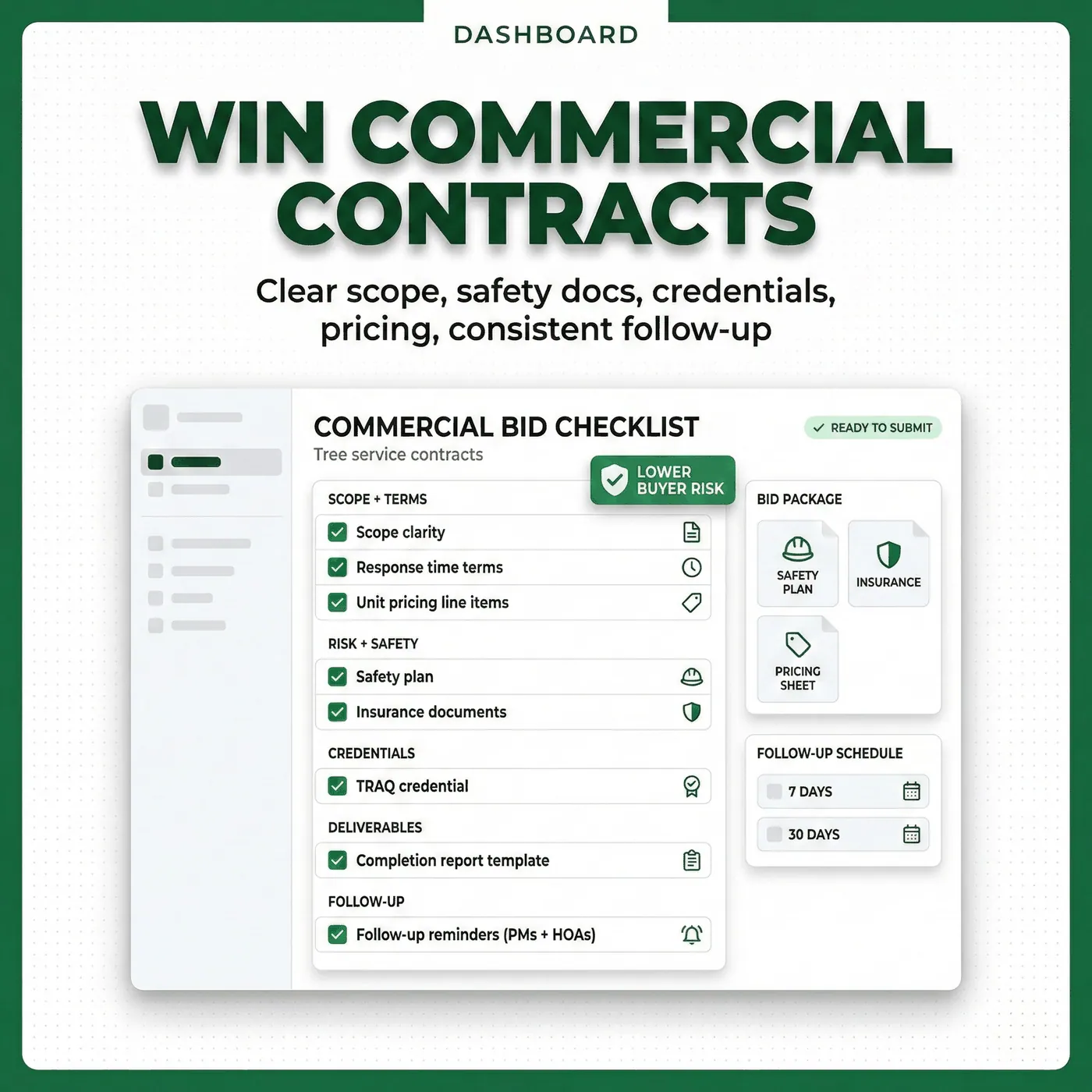
5. Your bid package: what to include every time
Most tree companies lose commercial bids because their quotes feel informal or incomplete.
Include these sections as standard:
A. Scope clarity
- exactly what is included
- exactly what is excluded
- assumptions: access, equipment, hours, traffic control needs
- disposal/haul-off and cleanup standards
B. Risk and safety plan (high-level)
- site protection steps
- crew qualifications (truthful and verifiable)
- process for work near utilities and hazard zones (if applicable)
C. Schedule and response
- standard lead times for routine work
- emergency response availability
- how you coordinate site access
D. Documentation deliverables
Commercial buyers love documentation because it reduces internal friction:
- work completion notes
- photo evidence
- risk observations (if relevant)
- recommendations for future maintenance
E. References and portfolio
- 3–5 relevant sites (similar property type)
- before/after photos
- testimonials that mention reliability and cleanup
If you want a tighter “how to win bids” playbook specific to tree services, even industry software providers publish tactical guides emphasizing estimate clarity, speed, and communication as consistent differentiators.
6. Pricing structure that buyers can approve
Commercial procurement hates ambiguity.
Offer pricing in formats they can approve quickly:
- per-tree or per-zone unit pricing for maintenance
- seasonal retainer for routine pruning cycles
- time-and-materials rates for emergency response (if their procurement allows it)
- line-item add-ons for stump grinding, crane work, traffic control, disposal
Avoid “one lump sum” whenever possible. Buyers want to understand what they are paying for.
7. Follow-up and retention: how to turn one job into a portfolio
The commercial win is not the first contract. It is the renewal.
After every commercial job:
- send a completion report
- include photos
- note any risk issues discovered and recommended next steps
- propose a maintenance calendar
Then ask for one thing:
“Do you want us to quote the next cycle now so it can be approved in advance?”
This is how you turn one site into recurring work.
8. A 30-day action plan
Week 1: Build your commercial foundation
- Create a commercial services page and capability statement
- Build your bid template with the sections above
- Prepare a “site completion report” template
Week 2: Build your target list
- 50 property managers and facility contacts in your service area
- 25 HOAs and multi-unit communities
- Identify the procurement portals relevant to your region
Week 3: Outreach and proof
- Email and call cadence: capability statement + request to be added as a vendor
- Publish 2–3 commercial case examples on your site (even if small)
Week 4: Procurement monitoring + bidding discipline
- Set a weekly rhythm for portal checks and tender alerts
- Submit only bids where you can meet the documentation and response requirements
FAQs
What is the fastest way to get commercial tree contracts?
Target property managers and HOAs with a commercial capability statement and a clean bid template, then follow up consistently.
Should I pursue government contracts?
Yes if you can handle documentation and compliance. Listings on SAM.gov show tree removal and trimming opportunities under NAICS 561730, and similar opportunities exist in municipal procurement plans in other countries.
Do credentials matter for commercial work?
They can. Standardized qualifications like ISA’s TRAQ help communicate risk assessment competence and can reduce buyer uncertainty.
How do I stand out if competitors underbid me?
Win on risk reduction: scope clarity, safety plan, documentation, response time, and reporting.
Where do I find tender opportunities?
In the US, SAM.gov is a primary source for federal opportunities. In South Africa, municipal procurement plans and treasury resources can surface upcoming needs. Always confirm on primary sources.
What should I include in a commercial tree service proposal?
Scope, safety approach, scheduling, documentation deliverables, references, and a clear pricing structure.