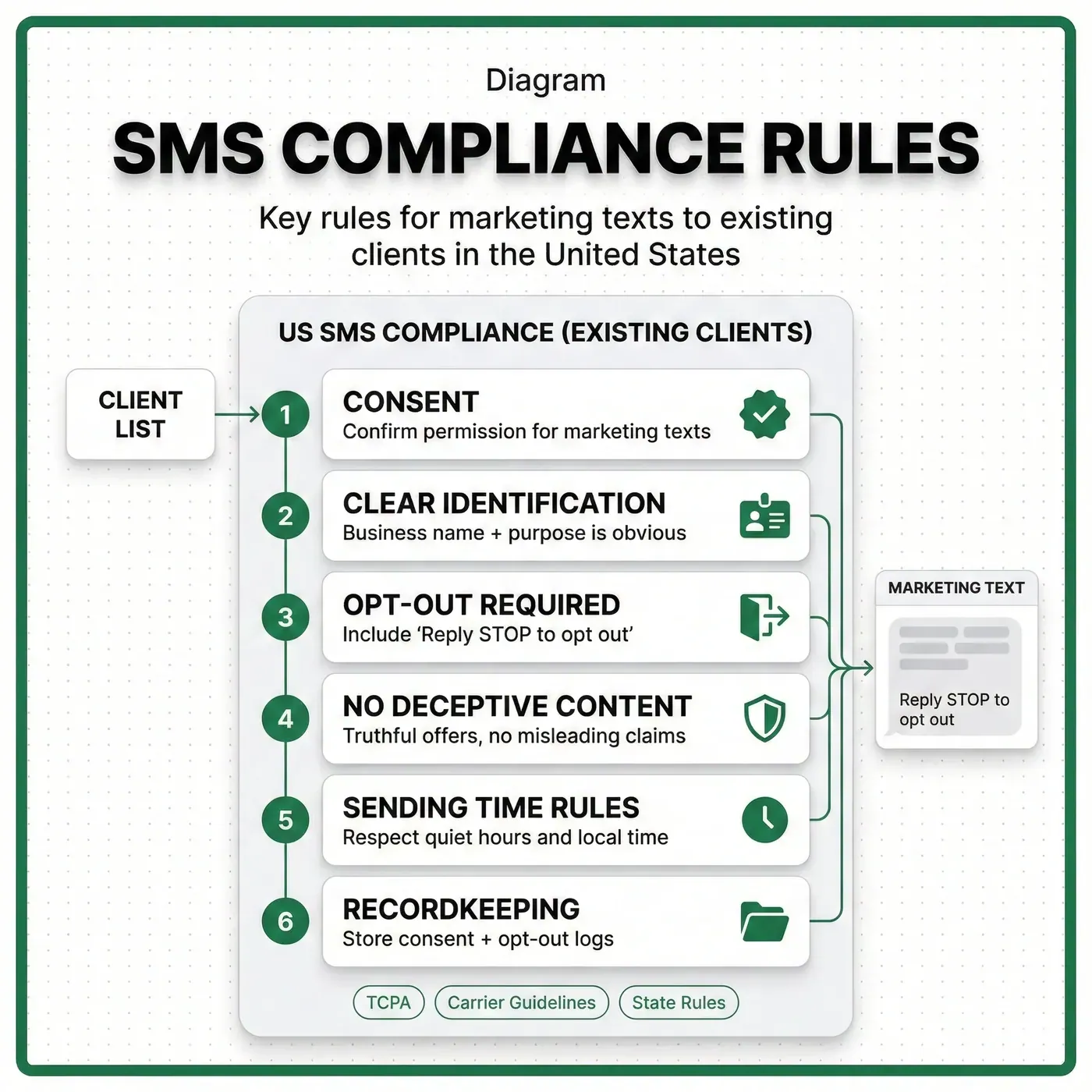
Marketing texts to existing clients in the United States are allowed only when strict consent, disclosure, timing, and opt-out rules are followed. Prior business relationships reduce friction, but they do not remove compliance obligations under federal and state law.
Why this topic causes confusion
Many businesses assume that an existing client relationship gives free rein to send marketing texts. That assumption comes from email rules, not SMS rules.
Text messaging is regulated more tightly.
Courts and regulators treat SMS as an intrusive channel. That means consent, timing, and message content matter even when the recipient already knows the business.
Most enforcement actions happen when companies rely on informal advice instead of written standards.
The laws that govern SMS marketing
SMS marketing in the US sits under a layered system.
Federal law sets the baseline. States add extra rules. Carriers add their own enforcement standards.
The main frameworks are:
- The Telephone Consumer Protection Act
- FCC regulations and guidance
- State consumer protection laws
- Carrier messaging policies
Compliance requires meeting the strictest applicable rule, not the easiest one.
What “existing client” actually means in SMS law
An existing client relationship does not equal open consent.
In SMS terms, consent must still be:
- Specific to text messages
- Clear and documented
- Given before marketing texts are sent
A past purchase, inquiry, or contract alone does not grant permission to text promotions.
The safest standard is express written consent that mentions SMS.
Consent requirements in practice
For most marketing texts, businesses need express consent.
That consent should include:
- Clear permission to receive marketing texts
- Identification of the sender
- Notice that message and data rates may apply
- Confirmation that consent is not a condition of purchase
Consent must be stored and retrievable. Screenshots, forms, or CRM records should show how and when it was collected.
Verbal consent is risky. Implied consent is weaker. Written consent is the standard regulators expect.
Timing and frequency rules
Federal guidance sets default quiet hours.
Marketing texts should be sent only between:
8 AM and 9 PM local time of the recipient
Some states narrow this window further.
Frequency also matters. Repeated texts can trigger complaints even with consent. Complaint volume is a major enforcement signal for carriers.
Fewer messages reduce risk.
Required disclosures inside the message
Every marketing text should identify the sender.
Messages should make it clear:
- Who is sending the text
- Why the recipient is receiving it
Vague or generic messages increase complaint rates. Clear identification reduces them.
Opt-out rules are not optional
Every marketing text must include a clear opt-out.
Common formats include:
- Reply STOP to unsubscribe
- Reply STOP to opt out
Opt-out requests must be honored immediately. Delays create liability.
Once a number opts out, it cannot be re-added without fresh consent.
What businesses get wrong most often
The most common compliance failures are predictable.
- Using old contact lists without SMS-specific consent
- Assuming existing customers equal permission
- Sending texts outside allowed hours
- Failing to log opt-outs correctly
- Relying on platform defaults instead of legal review
Many violations happen without bad intent. Intent does not matter in enforcement.
State law adds complexity
SMS compliance for marketing to existing clients becomes more complex at the state level, where regulations can exceed federal requirements.
These can include:
- Additional consent standards
- Registration or bonding requirements
- Private right of action for recipients
- Higher statutory damages
Businesses that operate across states must design campaigns to meet the strictest rule that applies.
This is why one-size SMS campaigns often fail.
Carrier enforcement is real
Even compliant campaigns can be blocked by carriers.
Carriers monitor:
- Complaint rates
- Message patterns
- Opt-out behavior
- Sender reputation
High complaint volume can shut down a campaign without warning.
Compliance reduces legal risk. It also reduces carrier risk.
How Valpo Agency approaches SMS compliance
Valpo Agency treats SMS as a regulated channel, not a growth hack.
The process starts with:
- Reviewing how consent is collected
- Confirming state coverage and risk
- Defining message purpose and cadence
- Designing clear opt-out handling
- Aligning campaign goals with legal limits
SMS is used when it fits the relationship and the rules.
Not every channel is right for every business.
Frequently asked questions
Can I text existing clients without written consent
In most cases, no. Written SMS consent is the safest standard.
Are transactional texts treated differently
Yes. Transactional texts face fewer restrictions, but marketing content inside them can trigger full compliance requirements.
Can platforms handle compliance automatically
No. Platforms provide tools, not legal protection. Responsibility stays with the sender.