Google Ads for Tree Services: The 2026 Complete Guide
How to build campaigns that generate exclusive, high-quality tree service leads at a cost-per-lead your competitors cannot match.
Why Google Ads Is the Fastest Way to Generate Tree Service Leads
When a homeowner has a tree hanging over their roof after a storm, they are not browsing social media. They are opening Google and typing “emergency tree removal near me.” They want a phone number. They want it now. Google Ads puts your business in front of that homeowner at the exact moment they are ready to spend money, and that is why paid search consistently delivers the fastest return on investment of any marketing channel available to tree service companies.
The challenge is that most tree service Google Ads campaigns are set up incorrectly. Broad match keywords drain budgets on irrelevant searches. Poorly written ad copy attracts clicks from DIY researchers rather than paying customers. Landing pages that send visitors to a generic homepage rather than a dedicated service page waste the majority of the ad spend. The result is a high cost-per-lead that makes the campaign feel unprofitable, when in reality the problem is execution, not the channel.
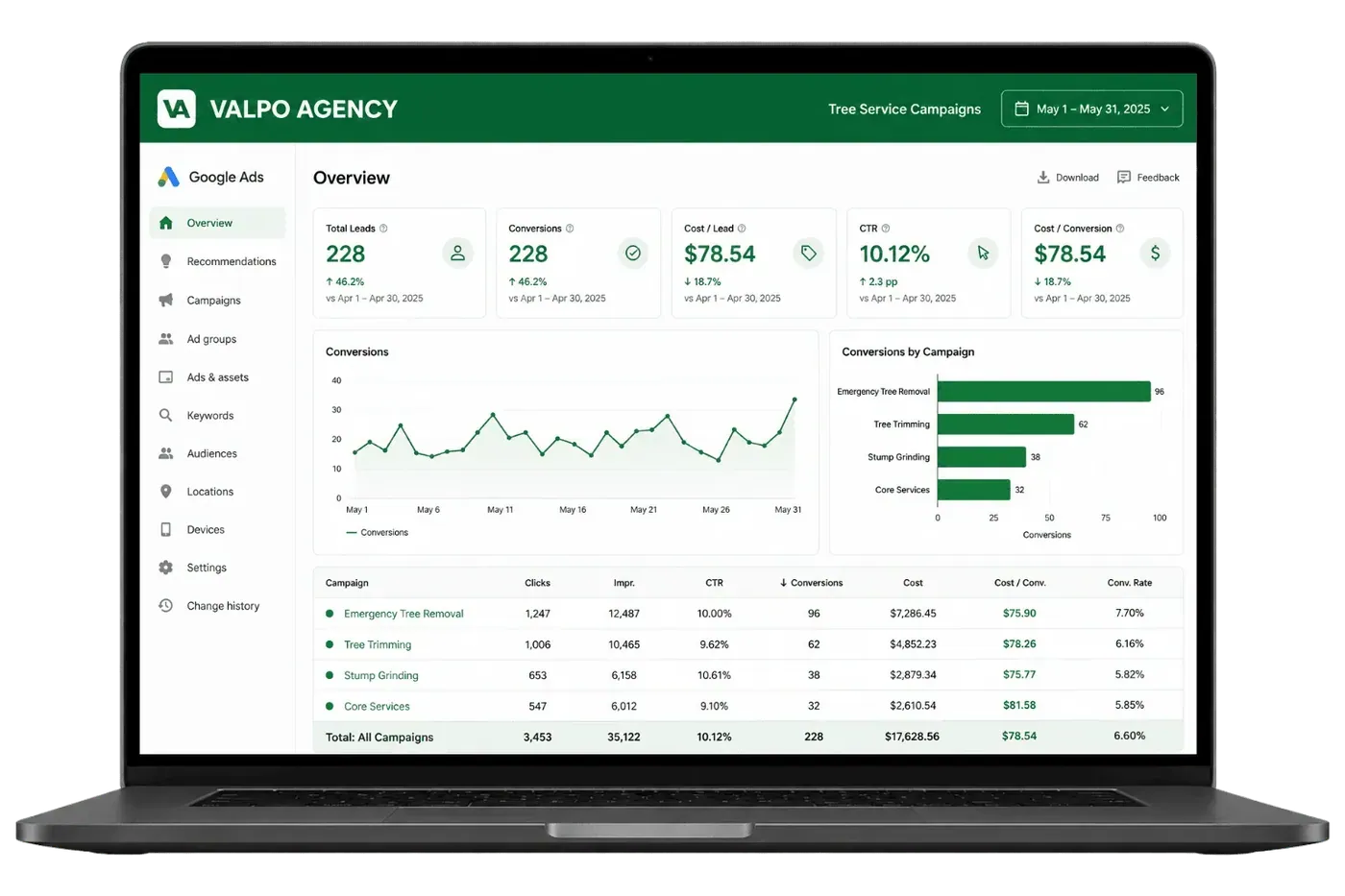
At Valpo Agency, our tree service Google Ads clients average a cost-per-lead of $65 to $90 for standard tree service keywords and under $50 for emergency tree service keywords. This guide breaks down exactly how we build and manage those campaigns.
See our client results including real campaign data from tree service companies we manage. →
How to Structure a Tree Service Google Ads Campaign
The most common mistake tree service owners make with Google Ads is running a single campaign with all of their services lumped together. This approach makes it impossible to control budgets by service type, write relevant ad copy for each service, and track which services are generating the best return.
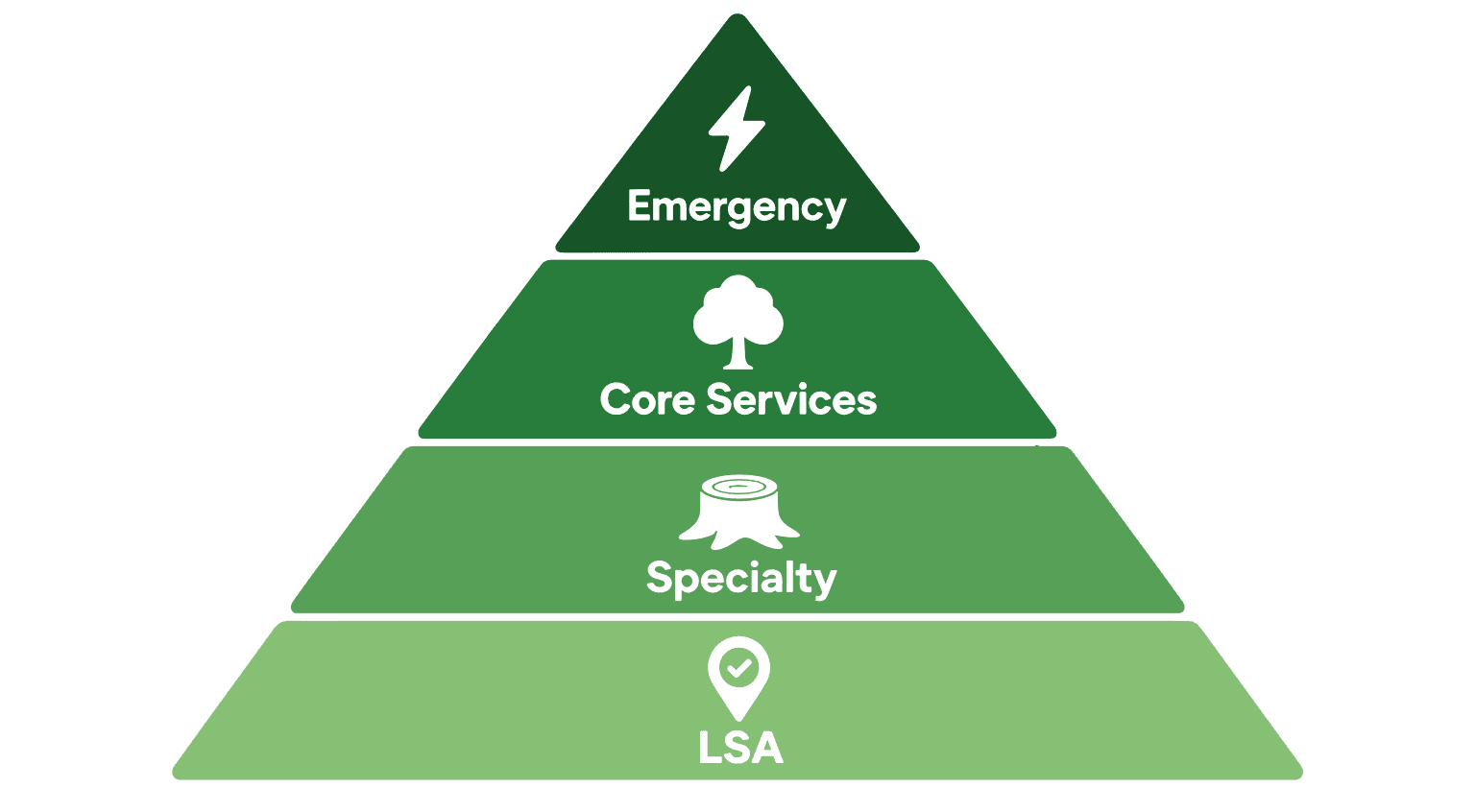
The correct structure for a tree service Google Ads account separates campaigns by service category and by intent level. A well-structured account for a tree service company typically includes the following campaign types.
Campaign 1 - Emergency Tree Service
Emergency tree service campaigns target the highest-intent, highest-value searches in the tree care industry. Keywords like “emergency tree removal,” “24 hour tree service,” “fallen tree removal,” and “storm damage tree service” attract homeowners in urgent situations who are not price-shopping. These campaigns should have the highest budget allocation and the most aggressive bidding strategy, because the average job value for emergency work is significantly higher than routine maintenance.
The landing page for emergency campaigns must load in under two seconds on mobile, display a phone number in the first visible area of the screen, and include a simple contact form. Every second of load time costs you a conversion.
Campaign 2 - Core Services (Tree Removal and Trimming)
Core service campaigns target the bread-and-butter keywords that drive consistent volume throughout the year. “Tree removal near me,” “tree trimming service,” “tree cutting service,” and “tree service [city]” are the foundation of most tree service businesses. These campaigns should use phrase match and exact match keywords to control spend and avoid irrelevant clicks.
Campaign 3 - Stump Grinding and Specialty Services
Stump grinding, lot clearing, and land clearing campaigns target homeowners with specific, high-value needs. These keywords have lower search volume than core service keywords but often deliver excellent cost-per-lead because there is less competition. A dedicated campaign allows you to write highly specific ad copy and send traffic to a dedicated landing page.
Campaign 4 - Local Service Ads (LSA)
Local Service Ads are a separate product from standard Google Ads but should be considered part of every tree service paid advertising strategy. LSAs appear above standard search ads and display your Google Guaranteed badge, your star rating, and your phone number. Because you only pay per lead rather than per click, LSAs often deliver the lowest cost-per-lead of any paid channel. They require a background check and license verification but are worth the setup effort.
Choosing the Right Keywords for Tree Service Google Ads
Keyword selection is where most tree service Google Ads campaigns succeed or fail. The goal is to capture searches from homeowners who are ready to hire, while filtering out searches from DIY researchers, students, and competitors.
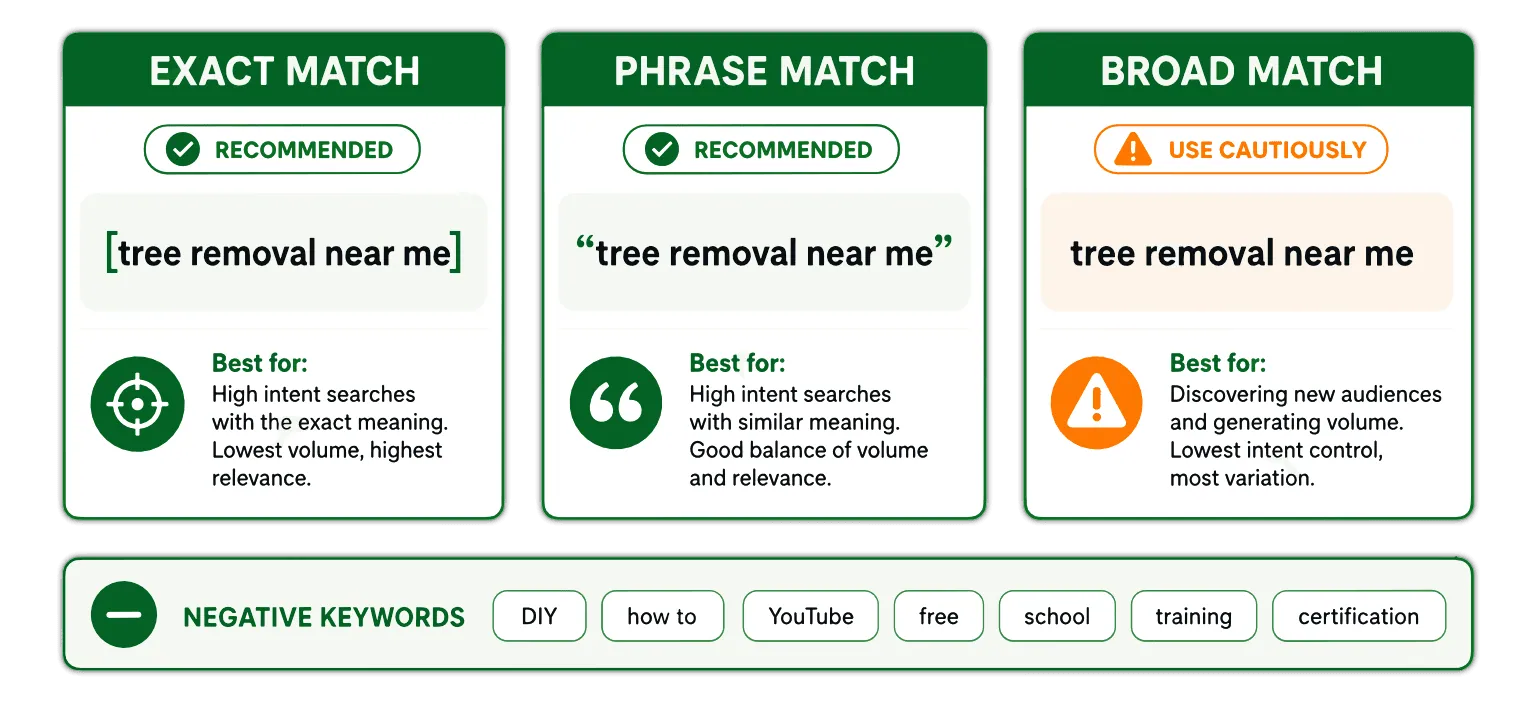
The three keyword match types available in Google Ads each serve a different purpose. Exact match keywords (written as [tree removal near me]) only trigger your ad when someone searches for that exact phrase or a very close variant. Phrase match keywords (written as “tree removal near me”) trigger your ad when the search contains your phrase in order. Broad match keywords trigger your ad for any search Google considers related to your keyword, which often includes irrelevant searches that waste budget.
For tree service companies, we recommend building campaigns primarily with phrase match and exact match keywords. Broad match can be used cautiously for discovery campaigns with a low budget and aggressive negative keyword lists, but it should never be the primary match type in a campaign where budget efficiency matters.
Negative keywords are as important as the keywords you bid on. Adding negative keywords like “DIY,” “how to,” “YouTube,” “free,” “school,” “training,” and “certification” prevents your ads from showing to people who have no intention of hiring a tree service company. A well-maintained negative keyword list can reduce wasted spend by 20 to 40 percent.
See the complete list of the best keywords for tree service companies in 2026. →
Writing Google Ads Copy That Gets Tree Service Calls
Your ad copy has one job: convince a homeowner to click your ad instead of a competitor’s. In a search results page where three or four tree service companies are all bidding on the same keyword, the ad with the most compelling copy wins the click.
The most effective tree service ad copy follows a simple formula. The headline should include the target keyword, a specific benefit, and a local signal. For example: “Tree Removal Nashville TN | Same-Day Service | Free Estimates.” The description should address the homeowner’s primary concern (usually safety and reliability), include a differentiator (licensed and insured, family-owned, 20 years experience), and end with a clear call to action.
Responsive Search Ads (RSAs) allow you to provide up to 15 headlines and 4 descriptions, and Google automatically tests combinations to find the best performers. We recommend writing headlines that cover three categories: keyword-focused headlines (Tree Removal Near Me, Emergency Tree Service), benefit-focused headlines (Same-Day Service, Free Estimates, Fully Insured), and trust-focused headlines (500+ 5-Star Reviews, Licensed Arborists, Family Owned Since 2005).
Ad extensions are a free way to increase the size and visibility of your ads. Call extensions display your phone number directly in the ad. Location extensions show your address. Sitelink extensions add links to specific pages like “Emergency Service,” “Free Estimate,” and “Our Reviews.” Using all available extensions consistently improves click-through rates and quality scores.
Landing Pages That Convert Tree Service Clicks Into Calls
Sending Google Ads traffic to your homepage is one of the most expensive mistakes a tree service company can make. A homepage is designed to introduce your business to someone who has never heard of you. A landing page is designed to convert someone who is already searching for a specific service into a phone call or form submission.
Every Google Ads campaign should send traffic to a dedicated landing page that matches the intent of the search. Someone who clicks an ad for “emergency tree removal” should land on a page that is entirely focused on emergency tree removal, with a prominent phone number, a brief description of your emergency response process, and a simple contact form. There should be no navigation menu, no links to other services, and no distractions.
The three elements that have the greatest impact on tree service landing page conversion rates are the above-the-fold phone number (visible without scrolling on mobile), social proof (Google review count and star rating), and a specific value proposition (Same-Day Response, Free Estimates, Fully Insured and Licensed).
How Much to Spend on Tree Service Google Ads
The right Google Ads budget for a tree service company depends on your market size, your average job value, and your growth goals. A company in a small market with an average job value of $800 needs a different budget than a company in a major metro area with an average job value of $2,500.
A useful starting framework is to work backward from your lead goal. If you want 30 exclusive leads per month and your target cost-per-lead is $75, you need a monthly budget of $2,250 for the ads themselves, plus management fees. If your market is competitive and your cost-per-lead is closer to $100, you need $3,000 in ad spend to hit the same lead volume.
For bidding strategy, we recommend starting with Maximize Conversions to allow Google’s algorithm to learn which searches convert best, then transitioning to Target CPA (Cost Per Acquisition) once the campaign has accumulated at least 30 conversions. This approach gives Google enough data to optimize effectively while keeping your cost-per-lead within a defined target.
Tracking What Matters: Leads, Not Clicks
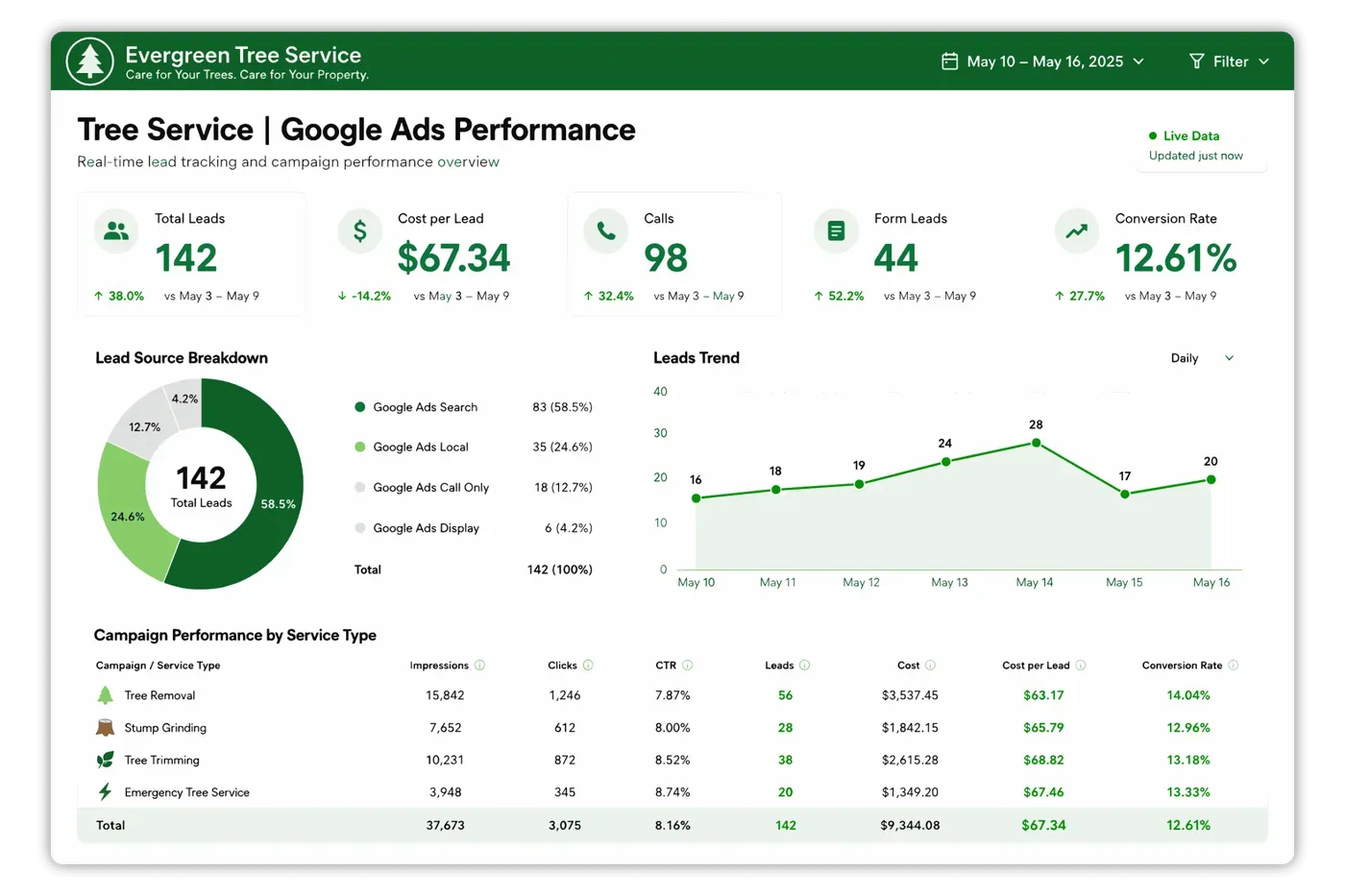
The most important metric in a tree service Google Ads campaign is not impressions, not clicks, and not click-through rate. It is cost-per-lead. Every other metric is a proxy for this number, and every optimization decision should be made in service of reducing it.
Proper conversion tracking requires setting up call tracking (so you can see which keywords and ads generate phone calls), form submission tracking (so you can see which ads generate form fills), and Google Analytics integration (so you can see the full customer journey from click to conversion). Without these three elements in place, you are flying blind.
At Valpo Agency, every client receives a real-time performance dashboard that shows total leads, cost-per-lead, lead source breakdown, and campaign performance by service type. This transparency allows us to make data-driven optimization decisions every week, not every quarter.
See how we track and report results for our tree service clients. →
Frequently Asked Questions About Google Ads for Tree Services
How much does Google Ads cost for a tree service company?
Tree service Google Ads budgets typically range from $1,500 to $5,000 per month depending on market size and competition. At Valpo Agency, our clients average a cost-per-lead of $65 to $90 for tree service campaigns.
What keywords should a tree service company bid on?
The highest-converting keywords are emergency tree removal, tree removal near me, tree trimming service, stump grinding, and 24 hour tree service. Location-specific keywords like “tree removal [city name]” also deliver strong ROI.
Should I use Google Ads or SEO for my tree service business?
Both channels work best together. Google Ads delivers immediate leads while your SEO campaign builds long-term organic visibility. Most successful tree service companies use Google Ads to fill their schedule while SEO compounds in the background. Internal link: Read our full comparison.
What is a good click-through rate for tree service Google Ads?
A well-optimized campaign should achieve a CTR of 8 to 15 percent for branded keywords and 4 to 8 percent for non-branded service keywords. Anything below 3 percent indicates your ad copy or targeting needs improvement.
Ready to Generate More Tree Service Leads With Google Ads?
Valpo Agency manages Google Ads campaigns for tree service companies across the United States. Our clients average a cost-per-lead under $90 and a return on ad spend that makes paid search their most profitable marketing channel. If you are ready to stop guessing and start growing, we would like to talk.