To optimize a tree service website for local search. It is about making your business easy for Google to verify, easy for homeowners to trust, and easy to contact from a phone in under ten seconds.
Table of contents
- What “local search optimized” means for a tree company
- The local SEO foundation you must get right
- Build service pages that rank for tree service searches
- Location signals without spam or doorway pages
- Conversion setup that turns rankings into calls
- Photos, proof, and trust signals that increase lead quality
- Structured data that helps local visibility
- A 30-day local optimization checklist
- FAQs
- SEO bundle and schema
1. What “local search optimized” means for a tree company
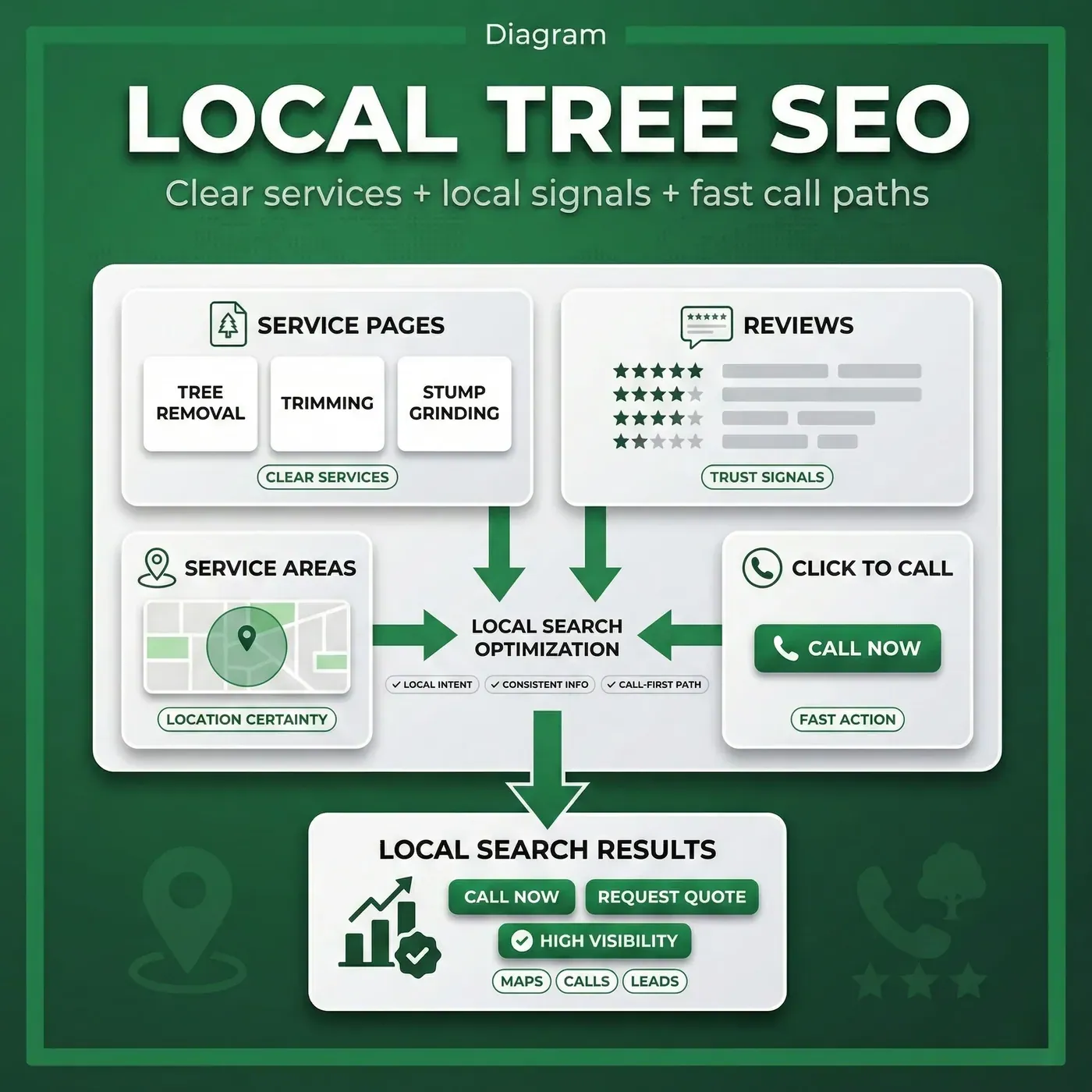
A tree service site is optimized for local search when:
- Google can verify who you are, where you serve, and what you do
- Your pages match the exact intent homeowners search (removal, trimming, emergency, stump grinding)
- Your site loads fast on mobile and makes calling effortless
- Your business information is consistent across your site and your Google presence
Local search is primarily a trust and relevance problem, not a creativity problem.
2. The local SEO foundation you must get right
Make your business details easy to confirm
Your website should display consistent business details across:
- Header or footer (phone, service area, business name)
- Contact page
- Schema
Consistency matters because local search depends on matching and validating business details. Google’s Business Profile resources emphasize accurate representation and management of business info, and their local business structured data documentation explains how structured data helps Google understand business details.
Optimize for mobile first
Most tree service searches are mobile and urgent. Your site should have:
- Click-to-call phone number always visible
- Short forms (if any) that take under a minute
- Fast load time and minimal heavy scripts
Build a logical site structure
At minimum, a tree service site should have:
- Homepage (service area + core service promise)
- Individual service pages (one per service)
- Service area coverage explanation (not spammy lists)
- About page (credibility and team)
- Contact page (call-first)
This aligns with Google’s general SEO guidance: make your site accessible, clear, and understandable so it can be shown in search results.
3. Build service pages that rank for tree service searches
A single “Services” page is rarely enough for local rankings.
Create separate pages for services people actually search:
- Tree removal
- Tree trimming and pruning
- Stump grinding
- Emergency tree service / storm cleanup
- Lot clearing (if offered)
- Tree health or risk assessments (if offered)
Each service page should include:
- A clear “what this is” definition
- When homeowners need it (symptoms and risks)
- Your process (simple steps)
- Safety and insurance language in plain English
- Proof: photos, reviews, equipment, experience
- Service area coverage
- A strong call-first CTA
If the page answers the homeowner’s questions, it is more likely to rank and convert.
4. Location signals without spam or doorway pages
Local SEO does require location clarity, but not thin “city pages” that repeat the same text.
Use:
- Natural location language (primary city plus nearby areas you actually serve)
- A “Service Areas” section that explains coverage logically (radius, counties, neighborhoods)
- Local proof: reviews that mention areas, job photos labeled by general location
- Case-study style writeups for real jobs (one per major area, if you have enough volume)
Avoid:
- Dozens of near-identical pages for every suburb
- Keyword-stuffed footers listing every town
The goal is legitimacy, not manipulation.
5. Conversion setup that turns rankings into calls
Local SEO is pointless if you do not convert.
Minimum conversion elements:
- Sticky click-to-call on mobile
- Primary CTA: Call Now or Request an Estimate
- A short estimate form (service type, location, timeline)
- Clear expectations after submission (response time, what info you need)
If your site makes people work to contact you, you will lose the lead to the next listing.
6. Photos, proof, and trust signals that increase lead quality
Tree work is high-stakes. Proof reduces fear.
Use proof blocks across key pages:
- Review count and star rating (if you can display it compliantly)
- Before/after galleries
- “Safety and insurance” section
- Real job photos showing cleanup and property protection
- Certifications and associations if applicable
Proof increases both conversion rate and lead quality because it filters out price shoppers and attracts serious homeowners.
7. Structured data that helps local visibility
Structured data is not a magic ranking hack, but it helps search engines interpret business details and can support local rich results.
Google’s documentation explains LocalBusiness structured data and what it can help Google display or understand (hours, departments, etc.).
For a tree service business site, the practical schema stack is:
- Organization
- WebSite
- WebPage
- LocalBusiness (or HomeAndConstructionBusiness with appropriate subtype if used)
- Service (optional for service pages)
- FAQPage (when the page contains FAQs)
- BlogPosting (for blog articles)
If your site is optimized for AI and local trust, schema is the “verification layer” that reduces ambiguity.
8. A 30-day local optimization checklist
Week 1: Fix the foundations
- Make phone number and service area consistent sitewide
- Tighten homepage headline to include core service + location
- Improve contact page and add click-to-call everywhere
Week 2: Build core service pages
- Create or upgrade the top 3 revenue services
- Add proof sections and clear CTAs
- Add FAQs based on real homeowner questions
Week 3: Improve trust and local validation
- Add a gallery section with real removals and cleanups
- Add a few short “job highlights” posts (real work, real outcomes)
- Ensure schema is implemented and error-free
Week 4: Fill gaps and strengthen structure
- Add the remaining service pages you offer
- Add internal links between related services
- Add a “Service Areas” explanation page if needed
FAQs
How long does local SEO take for a tree service website?
You can see improvements from site and profile fixes quickly, but competitive local rankings usually improve over weeks to months as Google reprocesses your site and trust signals.
Should I create a page for every suburb?
Only if you can make each page truly unique with real local proof and distinct content. Otherwise it usually becomes thin content and does not build trust.
What is the most important page for local rankings?
Your core service pages and the homepage typically matter most, because they match the highest intent searches.
Does schema help local SEO?
Schema helps Google interpret your business details and can support rich results, but it works best when your underlying content and business info are already strong.
What is the biggest conversion mistake tree companies make?
Hiding the phone number, using slow sites, and failing to prove credibility immediately.
Should I focus more on Google Business Profile or the website?
They work together. A strong Business Profile captures Maps intent and the website closes the trust gap and converts.