Google recently updated its ranking system, and the message is clear: generic, SEO-written articles are out. Helpful, experience-based content is in. This shift comes from the Helpful Content system, which is now fully integrated into Google’s core algorithm.
For tree service companies relying on local search to generate leads, this is a significant opportunity to stand out from competitors who are still using outdated tactics. The businesses that understand this shift and act on it quickly will dominate their local markets. The ones that ignore it will continue to lose ground.
When a homeowner has a tree emergency, they do not want to read a theoretical essay on arboriculture. They want to know that the company they are calling has handled this exact situation before, in their specific city, with a track record of success. Google’s new algorithm is designed to surface exactly that kind of proof.
What Actually Changed With Google?
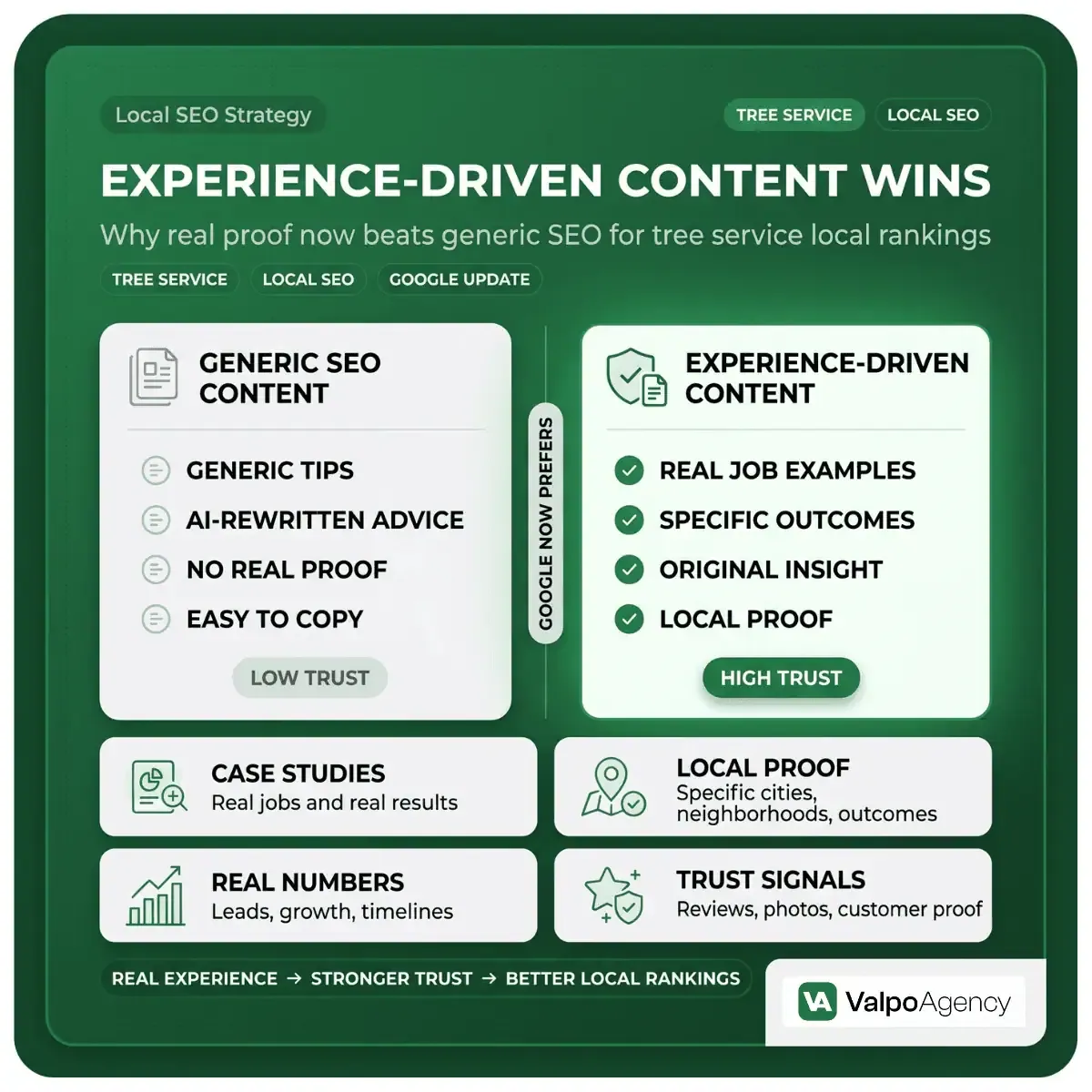
Google has shifted away from rewarding commodity content and is now prioritizing what can be called non-commodity content.
In simple terms, content written just to rank is being pushed down. Content based on real experience, real work, and original insight is being pushed up. Furthermore, Google now evaluates entire websites, not just individual pages. That means one strong article is not enough. Your entire online presence needs to reflect genuine expertise.
This is a departure from the old days of SEO, where a company could hire a cheap writer to spin out 500 words on “why tree trimming is important” and see a boost in rankings. Today, Google’s systems are sophisticated enough to recognize when content is merely echoing what is already on the internet versus when it is bringing new, first-hand experience to the table.
Commodity vs. Non-Commodity Content
To understand the shift, you have to look at the difference between what works and what no longer does.
A “Top 10 Tips for Tree Pruning” article is commodity content. A case study showing how your crew safely removed a 60-foot oak near a powerline in a tight residential yard, with photos, a timeline, and a satisfied homeowner review, is non-commodity content. One of those ranks. The other gets buried.
What Google is Looking For Now
Google is actively rewarding content that shows first-hand experience, real examples and outcomes, original data or insights, and clear evidence that the author has done the work.
At the same time, Google is devaluing generic blog posts, rewritten or AI-generated summaries, and content that adds no new information to the conversation.
The shift is simple. Google moved from asking “Does this match the keyword?” to asking “Did this come from someone with real expertise?”
As the principle goes: the writing is the easy part. The sourcing is the job. That means real quotes, real datasets, real case studies, and real outcomes are now ranking signals, not just optional additions to a blog post.
When evaluating a website, Google looks for signals that indicate the business is an active, functioning entity with real customers. This includes mentioning specific neighborhoods you serve, detailing the equipment used for specific jobs, and providing transparent explanations of your process.
Why This Matters Specifically for Tree Service Local SEO
Local SEO for tree service companies is not just about keywords and backlinks. It is about trust. When a homeowner searches for “tree removal near me” or “emergency tree service in
| Type | Commodity Content | Non-Commodity Content |
|---|---|---|
|
Source |
Can be written by anyone |
Comes from real, hands-on work |
|
Style |
Generic tips and advice |
Specific outcomes and real examples |
|
Replicability |
Easily copied or AI-generated |
|
|
Value |
Adds nothing new |
Adds original insight and proof |
[city],” they are not looking for a company that sounds good. They are looking for a company they can trust to show up, do the job right, and not damage their property.
Google understands this. That is why it is rewarding businesses that can prove their expertise through real content, not just claim it.
Your Google Business Profile, your website content, your case studies, and your reviews all work together to build that trust signal. When they are aligned and grounded in real experience, Google surfaces your business first. When they are generic and templated, you disappear.
Consider the typical customer journey for a tree service lead. A storm hits overnight. A homeowner wakes up to find a large branch resting on their roof. They pull out their phone and search for emergency tree removal. They are going to click on the first few results in the Google Map Pack. If your website and profile show real photos of storm cleanup, real reviews mentioning fast response times, and specific details about how you handle emergency calls, you win the job. If your site just has a stock photo of a tree and a generic paragraph about your services, the homeowner will keep looking.
How Valpo Agency Builds Local SEO Around Real Results
At Valpo Agency, the approach to Local SEO is built on the same principle Google is now rewarding. Every piece of content, every case study, and every service page is built around real work, real data, and real outcomes from actual client campaigns.
This is not a new strategy. It is how Valpo Agency has operated from the beginning. The Google update simply confirms that this approach is the right one.
Here is what that looks like in practice:
Real case studies from actual client work. Every result Valpo Agency publishes is tied to a real campaign, a real business, and a real outcome. There are no fabricated numbers or theoretical projections.
Content built around real scenarios. Service pages and blog posts are written around how homeowners actually search and what they actually need, not around what sounds good in a content brief.
Data that is sourceable. Every claim is backed by something real, whether that is a client’s lead count, a revenue figure, or a documented change in search rankings.
We do not ask our clients to become writers. We ask them to share their wins, their challenges, and their processes. We then take that raw, real-world experience and turn it into highly optimized, non-commodity content that Google loves and homeowners trust.
Real Results That Prove the Model
The best way to understand why experience-driven Local SEO works is to look at what it produces. When you stop chasing algorithms and start publishing proof of your competence, the growth is measurable.
T&T Tree Service partnered with Valpo Agency and went from receiving 1 to 2 leads per day to consistently generating 15 or more leads daily. The result was 203% revenue growth in a single year, driven by website management, Google Ads, and Local SEO working together as a connected system.
G2G Tree Service had a website that brought in just 60 organic leads over 3.5 years with their previous provider. After switching to Valpo Agency, they saw more than 30 organic leads in just 30 to 45 days. These were high-quality leads that converted, not just traffic numbers.
Beez Trees achieved 500% lead growth in 12 months, turning consistent, experience-based marketing effort into a measurable and repeatable lead generation system.
These results are not the product of keyword stuffing or generic blog posts. They come from building a marketing system grounded in real strategy, real execution, and real proof.
What to Focus On Going Forward
To stay aligned with Google’s update and dominate your local market, the focus should remain on the following principles.
Keep using real numbers, timelines, and results in your content. Specificity builds trust with both Google and homeowners. Include details tied to actual projects, such as the type of tree, the location, the challenge involved, and the outcome. Show what was done, what changed, and why it mattered. Avoid overly generic or templated language that could have been written about any tree service in any city.
The more your content reflects real-world execution, the stronger it performs in local search.
Furthermore, make sure your website architecture supports this content. A great case study hidden on page four of your blog will not help you. Real results need to be front and center on your homepage, your service pages, and your contact page. Every touchpoint a customer has with your brand should reinforce your expertise.
Frequently Asked Questions About Tree Service Local SEO
Based on what tree service owners are actively asking, here are the most critical questions regarding local search visibility.
1. How do I get my tree service to rank higher on Google Maps?
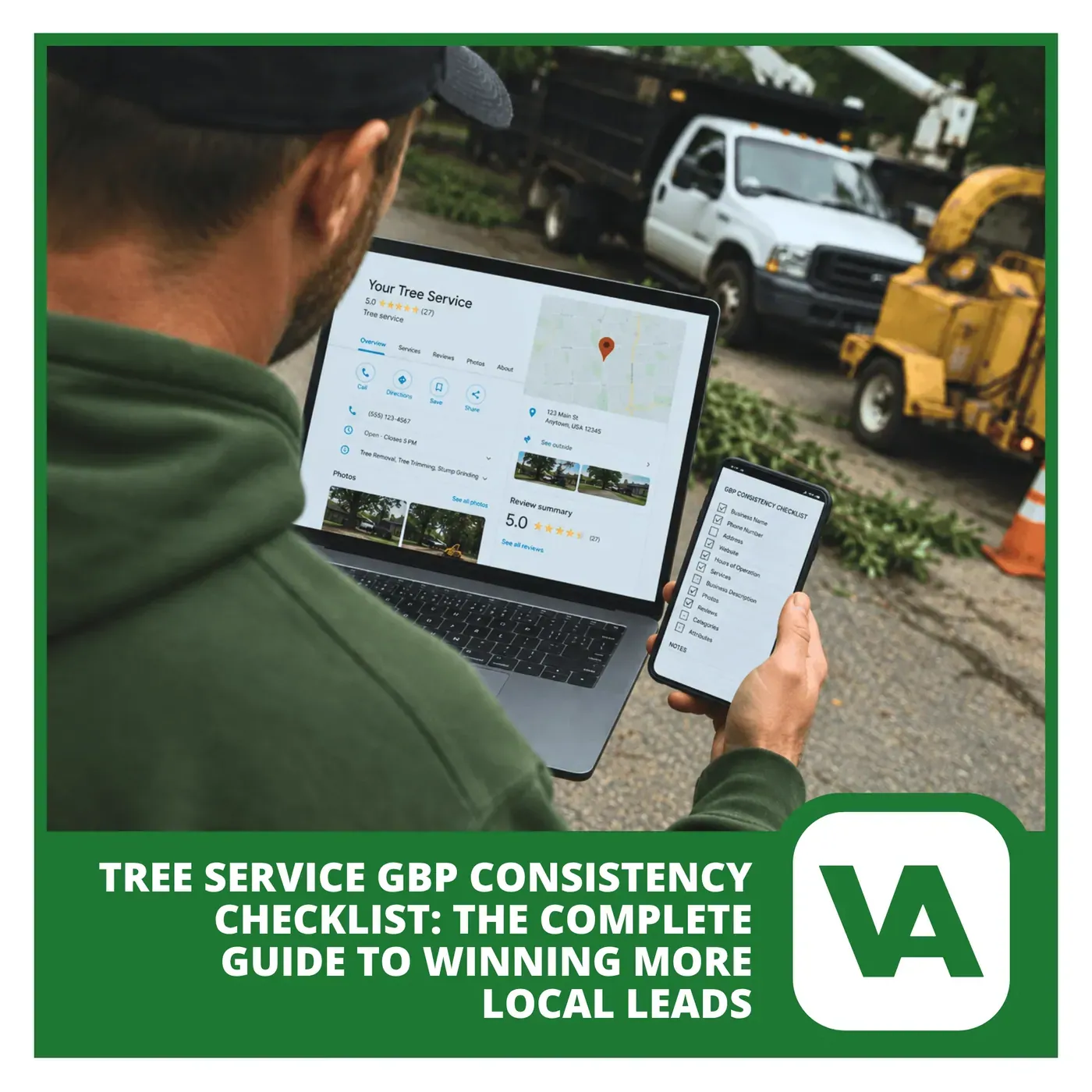
Ranking higher in the Google Map Pack requires a fully optimized Google Business Profile. Ensure your primary category is set to “Tree Service” and add all relevant secondary categories like “Arborist” or “Landscaper.” Keep your Name, Address, and Phone Number (NAP) perfectly consistent across all online directories. Most importantly, consistently gather high-quality reviews and post updates with real photos from your job sites.
2. What are the best local SEO keywords for tree service companies?
The best keywords are a mix of high-intent services and your specific location. Examples include “tree removal near me,” “emergency tree service [City],” “stump grinding [City],” and “arborist [City].” Focus on the exact phrases homeowners use when they have an urgent problem or are planning a landscaping project.
3. How often should a tree service company post new content for SEO?
Consistency matters more than volume. Aim for at least one to two high-quality, experience-based posts per month. Instead of publishing four generic articles, publish one detailed case study about a complex removal job you recently completed. Google prefers deep, authoritative content over shallow, frequent updates.
4. Does having a blog actually help a tree service get more leads?
Yes, but only if the blog answers real questions homeowners have. A blog post titled “What to do if a tree falls on your roof in [City]” captures high-intent traffic. A generic post about “The history of the oak tree” does not. Blogs help you rank for long-tail keywords and establish your company as the local authority.
5. Why is my tree service website getting traffic but no calls?
High traffic with low conversions usually points to a trust or user experience issue. Your site might be ranking for broad terms but failing to provide clear calls-to-action (CTAs). Ensure your phone number is clickable and highly visible at the top of the page. Add real photos of your crew and equipment, and feature customer reviews prominently to build immediate trust.
6. How long does it take to see results from local SEO?
Local SEO is a long-term strategy. While optimizing your Google Business Profile can yield improvements in a few weeks, moving up in organic search rankings typically takes three to six months of consistent effort. The timeline depends on the competitiveness of your market and the current state of your website.
Bottom Line
Google’s update rewards evidence over explanation. Businesses that build their online presence around real experience, real outcomes, and real proof will rise in local search. Businesses that continue publishing generic content will fall further behind.
Your tree service already has the raw material. Every job you complete, every satisfied customer, and every challenge you solve is a content opportunity. The question is whether you are using it.
At Valpo Agency, we help tree service companies turn that real-world experience into a Local SEO system that generates consistent leads, builds market authority, and keeps your business growing year over year.
Ready to build a Local SEO strategy around your real results?
Schedule a Free Discovery Call with Valpo Agency today. We will show you exactly how to turn your experience into a lead generation system that works.