To set up targeted ads for tree removal and maintenance, split your advertising by intent, prioritize Google platforms that capture hire-ready local searches, and build landing pages and tracking that connect every call and form submission back to booked jobs, not just clicks.
Table of contents
- What “targeted ads” really means for tree services
- The three ad channels that consistently produce tree leads
- Step 1: Set up tracking so you can measure booked work
- Step 2: Build landing pages that convert removal and maintenance
- Step 3: Google Local Services Ads for hire-ready leads
- Step 4: Google Search Ads for removal and maintenance
- Step 5: Meta ads for maintenance and retargeting
- Step 6: Targeting rules that prevent out-of-area leads
- Step 7: Lead quality filters that stop time-wasters
- A 14-day launch plan
- FAQs
- SEO bundle and schema
1. What “targeted ads” really means for tree services
Targeted ads are not about clever messaging. They are about controlling four variables:
- Intent: removal and emergency are different from trimming and maintenance
- Location: you only want leads inside your actual service area
- Offer: what you want them to do next (call now, request an estimate, book an inspection)
- Proof: the trust signals that reduce fear (reviews, insurance, job photos)
If you control those, ad platforms become predictable.
2. The three ad channels that consistently produce tree leads
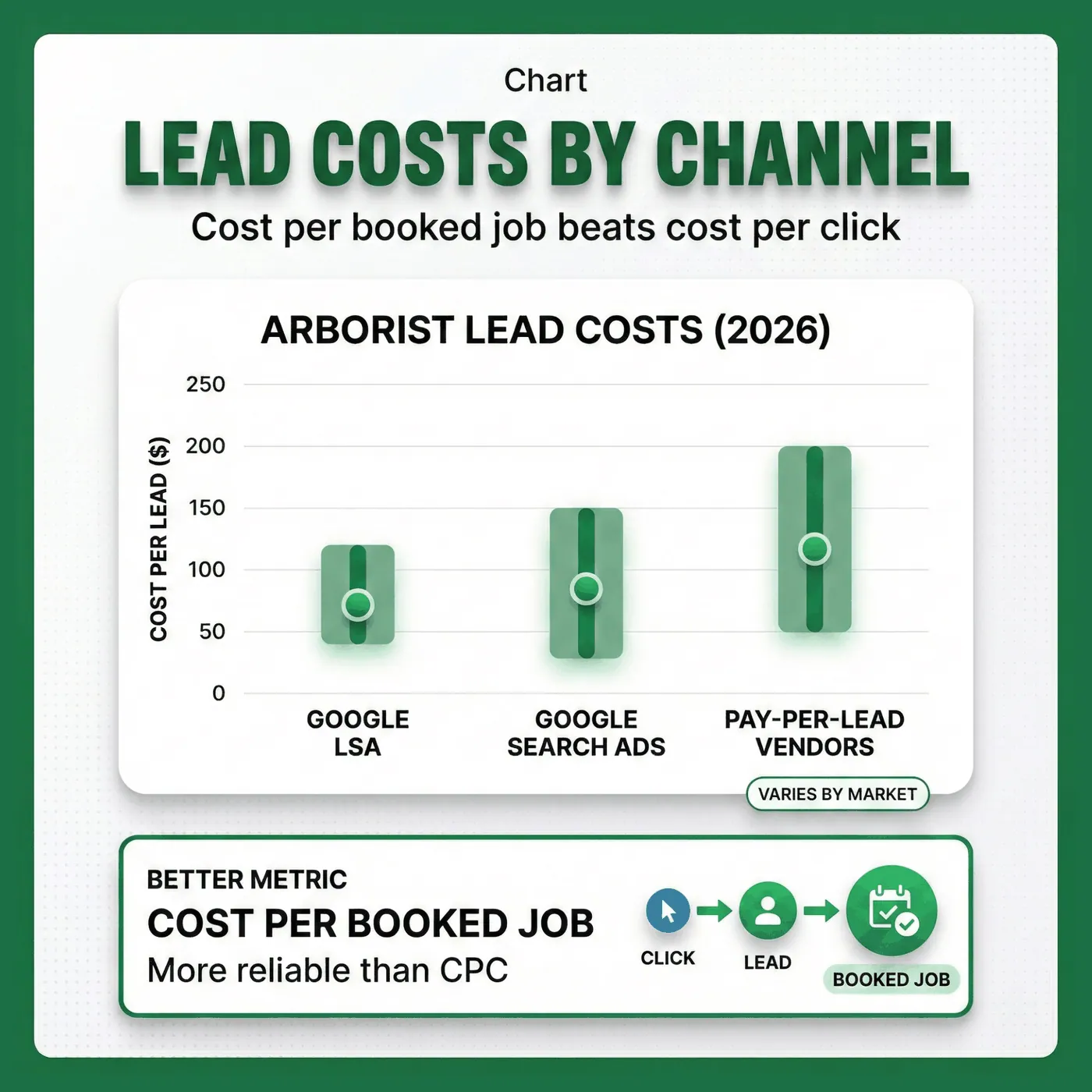
Tree businesses usually win from these channels, in this order:
- Google Local Services Ads (LSAs)
Google describes LSAs as ads that connect local businesses with customers searching for services, and you receive leads like calls and messages directly through the ad experience. - Google Search Ads (Paid Search)
This is where you buy high-intent keywords like “tree removal near me” and “stump grinding,” and route traffic to the exact service page that matches that intent. - Meta (Facebook/Instagram) for maintenance and retargeting
Meta is rarely the best “urgent hire” channel, but it can fill the pipeline for maintenance and keep you top-of-mind.
The best setups use Google for hire-ready demand, Meta for nurturing and follow-up.
3. Step 1: Set up tracking so you can measure booked work
If you skip tracking, you will optimize for noise.
Minimum tracking setup:
- Call tracking (so you know which channel produced the call)
- Conversion tracking for forms and quote requests
- A way to mark leads as qualified and booked (even a simple spreadsheet works)
Why this matters: tree work is high variance. One emergency removal can be worth more than twenty low-quality form fills. You need to see which campaigns produce booked jobs.
4. Step 2: Build landing pages that convert removal and maintenance
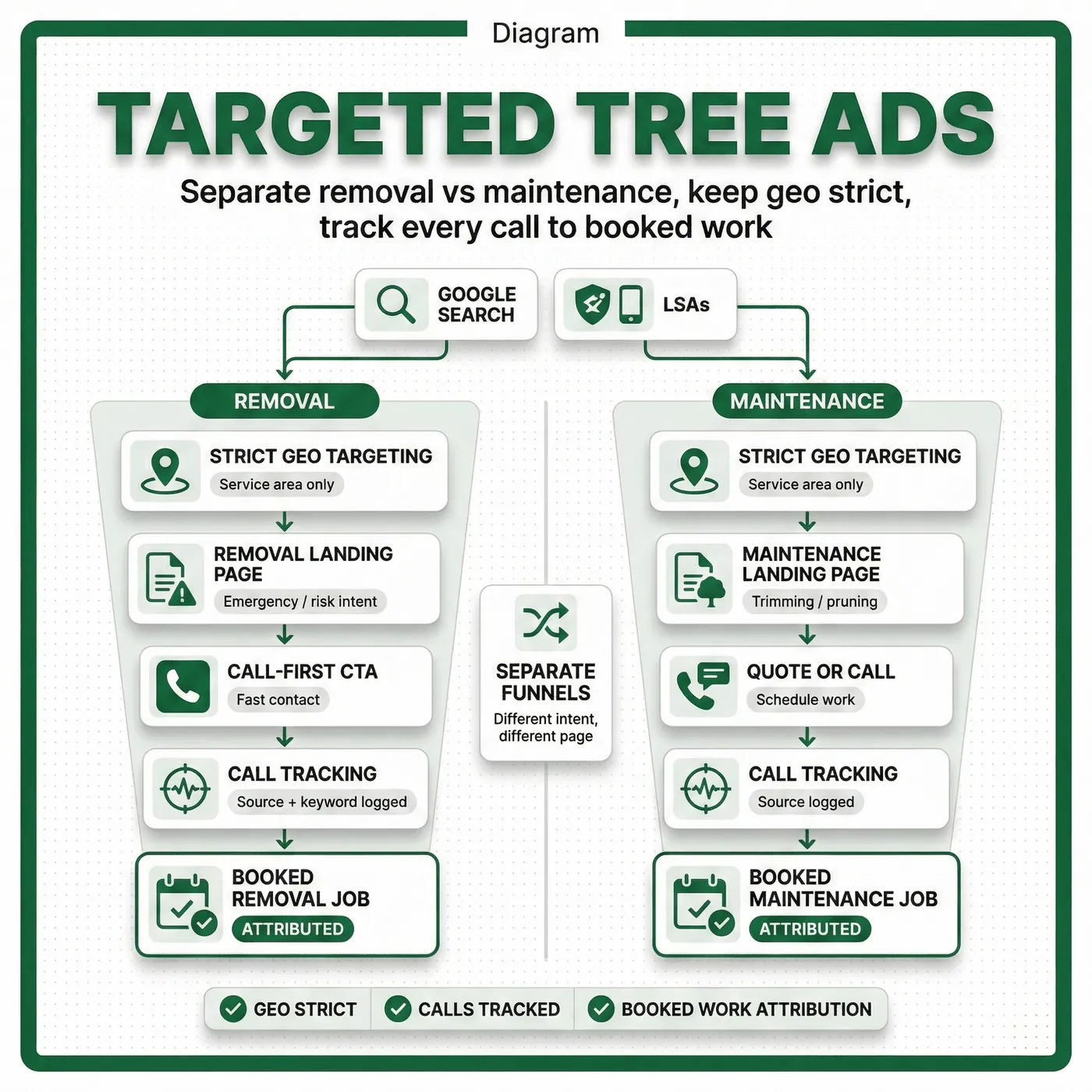
Do not send all traffic to your homepage. Create two conversion paths:
Landing page A: Tree removal and emergency
This page should be call-first and proof-heavy:
- Emergency and removal headline with the service area
- Click-to-call button and phone number visible immediately
- Proof above the fold: reviews, “insured,” safety-first messaging
- Process section: what happens next (assessment, safety plan, removal, cleanup)
- Photo proof: before/after and cleanup shots
- Short FAQ section for urgent objections
Landing page B: Maintenance and trimming
This page should be plan-first and schedule-friendly:
- Trimming and maintenance headline with the service area
- “Request an estimate” form and click-to-call
- Services list: pruning, trimming, shaping, deadwood removal, stump grinding if offered
- Seasonal positioning: when to trim, what maintenance prevents
- Proof and portfolio
Your ads will convert better simply because the page matches the search intent.
5. Step 3: Google Local Services Ads for hire-ready leads
LSAs are built for local service lead capture. Google states LSAs connect you with customers searching for services and generate leads directly.
Setup rules that matter
- Choose the services you actually want (removal vs trimming)
- Set your service area precisely
- Use call handling discipline: answer fast, follow up fast
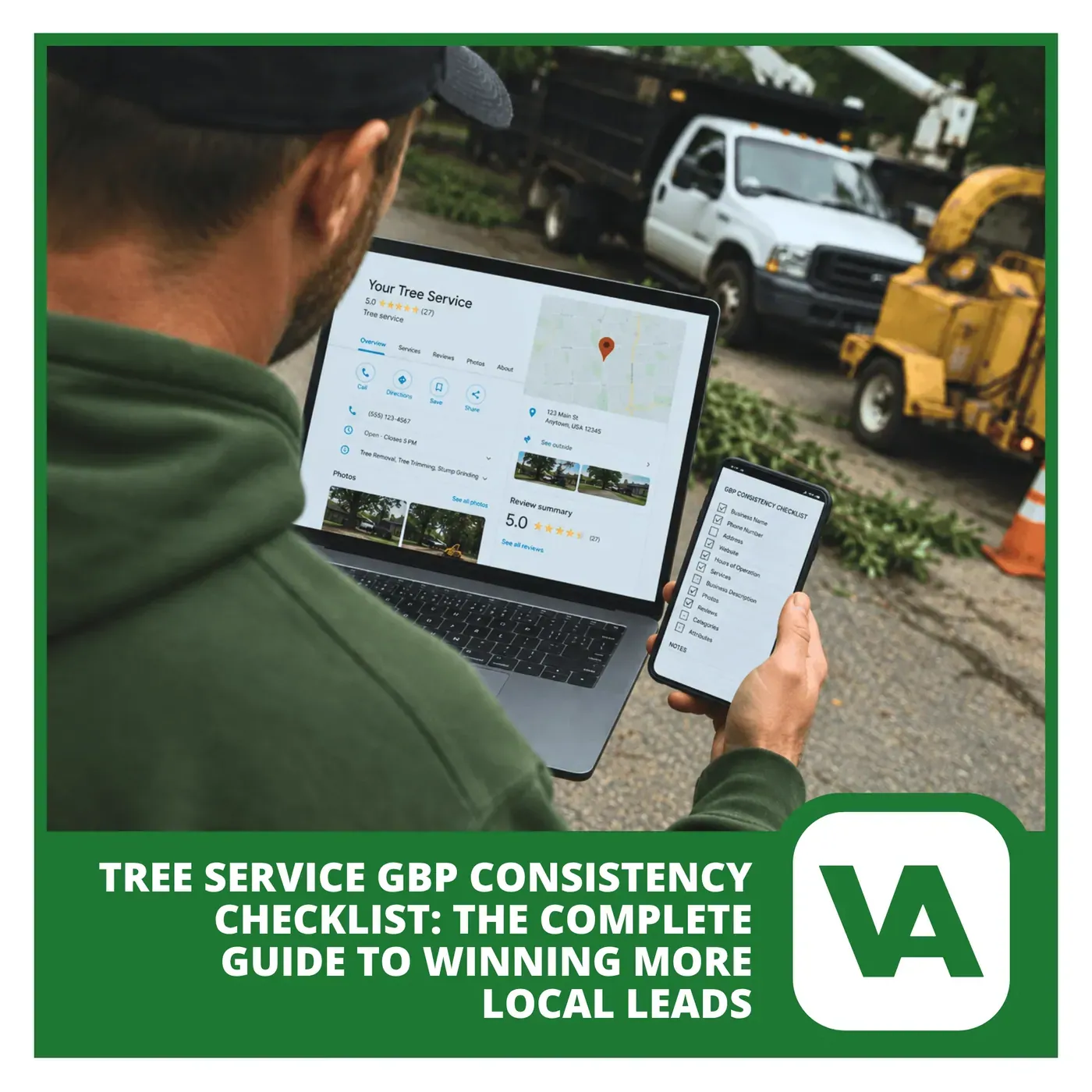
- Keep business details consistent across the web
When LSAs are the best fit
- Emergency and removal
- “Near me” buyers who want the first credible provider to answer
LSAs can produce great leads, but only if your intake process is tight.
6. Step 4: Google Search Ads for removal and maintenance
Search Ads are where you control intent at the keyword level.
Campaign structure that works
Create two campaigns:
Campaign 1: Tree Removal and Emergency
Ad groups:
- Emergency tree removal
- Fallen tree removal
- Dangerous tree removal
- Tree removal near me
Campaign 2: Tree Maintenance
Ad groups:
- Tree trimming service
- Tree pruning near me
- Stump grinding (optional)
- Tree maintenance service
Keywords to start with
Removal intent:
- tree removal near me
- emergency tree service
- fallen tree removal
- remove dangerous tree
Maintenance intent:
- tree trimming service
- tree pruning near me
- seasonal tree trimming
- tree maintenance company
Negative keywords you should add immediately
To reduce junk:
- jobs, salary, training, certification
- diy, how to, free, pictures
- definition, meaning
This is one of the simplest ways to improve lead quality quickly.
The ad copy rule
Do not write poetic ads. Write ads that qualify:
- “Tree Removal and Cleanup”
- “Insured, Safety-First Crew”
- “Fast Estimates, Local Service Area”
- “Call Now” for urgent; “Request an Estimate” for maintenance
7. Step 5: Meta ads for maintenance and retargeting
Meta can work well when you:
- target homeowners in your service areas
- use proof-heavy creative (before/after, reviews, crew on-site)
- use a lead form with qualifiers
The best Meta use cases
- Maintenance plans and seasonal trimming
- Retargeting people who visited your removal or trimming pages
- Storm season awareness (availability messaging)
Lead form qualifiers that improve quality
- Service needed (removal, trimming, stump grinding)
- Suburb/ZIP
- Timeline (urgent, this week, this month)
- Permission to call and best time to reach them
If you do not qualify, you will spend your team’s time chasing low-intent messages.
8. Step 6: Targeting rules that prevent out-of-area leads
Out-of-area leads are almost always a targeting problem.
Rules to apply:
- Only target the exact cities/ZIPs you serve
- Exclude areas you cannot service
- Set ads to show only in those locations (not “interested in”)
Also, align service areas across:
- your ads
- your landing pages
- your Google Business Profile
This reduces confusion and improves both lead quality and close rate.
9. Step 7: Lead quality filters that stop time-wasters
Most “bad leads” come from missing filters.
Add filters in two places:
On the form
- Service type dropdown
- Location required
- Timeline required
- Optional photo upload
In your confirmation message
Set expectations:
- response window
- what they should prepare (address, photos, access notes)
- emergency protocol if applicable
This simple structure reduces ghosting and improves conversion.
10. A 14-day launch plan
Days 1–3: Foundation
- Build two landing pages (Removal, Maintenance)
- Set up call tracking and form tracking
- Write simple ad copy that qualifies
Days 4–7: Launch Google
- Start LSAs if eligible
- Launch Search Ads with tight geography
- Add negative keywords immediately
Days 8–14: Optimize fast
- Review search terms and block junk
- Improve landing page proof sections
- Adjust budgets toward the campaign producing booked jobs
You should be looking at booked work signals by week two, not vanity metrics.
FAQs
Should I advertise removal and maintenance together?
No. They have different intent, different urgency, and different conversion paths. Split them.
What is the best channel for emergency tree removal leads?
Google channels usually capture urgent intent best because homeowners actively search for help, and LSAs are specifically designed to connect local businesses with customers searching for services.
How do I stop getting low-quality leads?
Tighten location targeting, add negative keywords, use service-specific landing pages, and add qualification questions in your forms.
Do I need a website if I run ads?
Yes. A website is the conversion layer. Ads without strong landing pages raise your CPL and reduce lead quality.
What should I track weekly?
Calls, qualified leads, booked jobs, close rate, and cost per booked job by channel.
Should I use Facebook ads for tree removal?
It can work, but it is typically better for maintenance and retargeting than urgent removal.