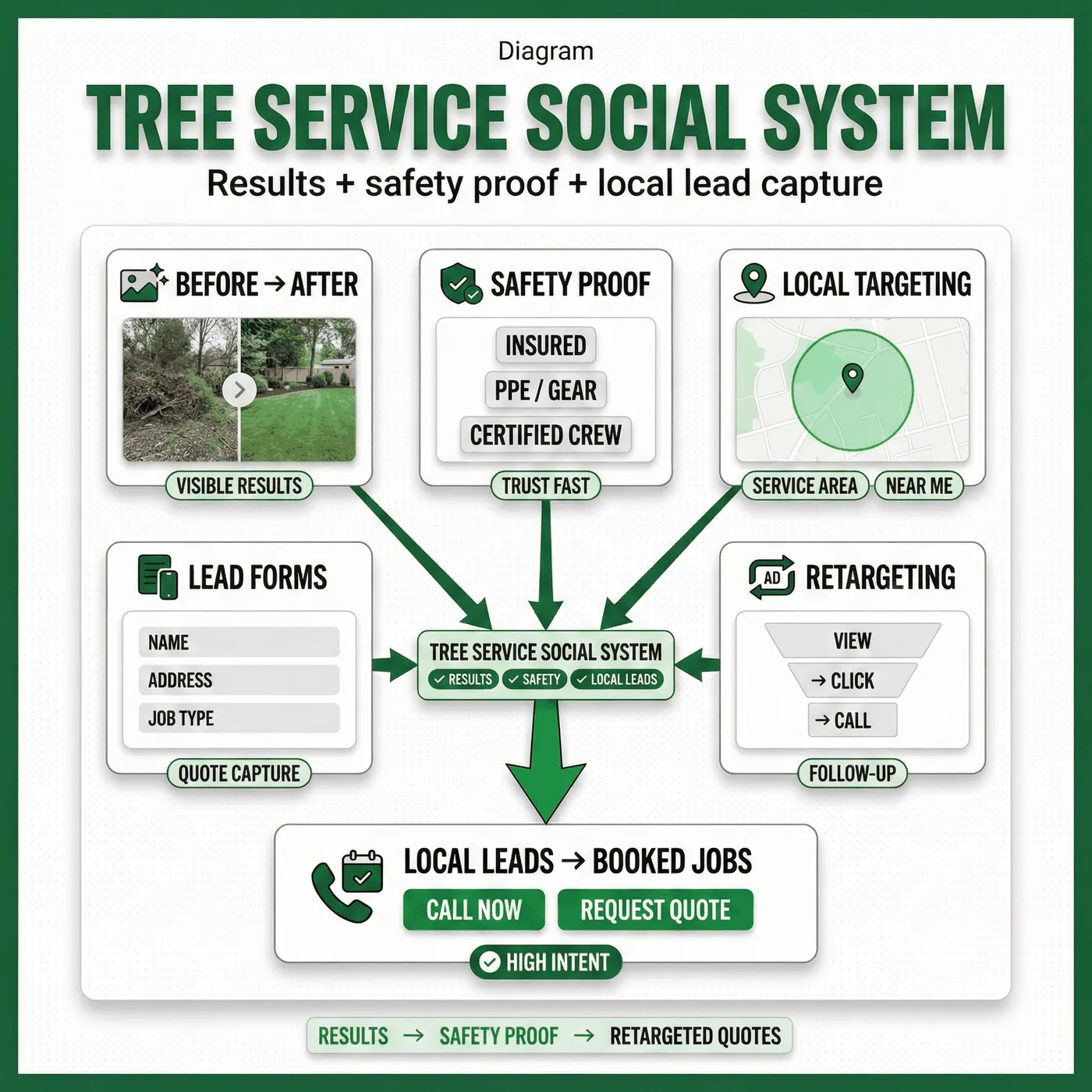
Effective social media for tree service companies is a local proof engine: publish visible job transformations and safety credibility consistently, make it easy to request an estimate, and use neighborhood platforms and lead-form ads to reach homeowners in your service area, then retarget engaged viewers until they book. Nextdoor explicitly positions “Home & Garden” advertising as a way to reach hyper-local customers, and both Nextdoor and Meta provide lead-generation ad tools designed to capture contact details directly.
Table of contents
- What “effective” means for a tree service company
- The 4 content pillars that generate tree leads
- The formats that work best for tree services
- Local distribution: how to reach homeowners, not random viewers
- Lead capture that doesn’t attract time-wasters
- Retargeting: how tree leads actually close
- A simple weekly posting plan
- Common mistakes that create low-quality enquiries
- FAQs
- SEO bundle and schema
1. What “effective” means for a tree service company
Effective is not likes. Effective is:
- Estimate requests from homeowners in your service area
- Calls for removals and storm response
- Booked site visits for trimming and maintenance
If your social content is not producing any of those, you are doing brand awareness by accident.
2. The 4 content pillars that generate tree leads
Pillar 1: Transformations
This is the fastest trust builder in tree services because the outcome is visual.
What to post:
- Before and after (same angle)
- A 3-line breakdown: problem, solution, result
- One scope cue so the right customer self-qualifies (tree size, access constraints, crane vs climb, cleanup included)
Caption template:
“Removed a storm-damaged oak, protected the roofline, full haul-off and cleanup. Serving [area]. Call or request an estimate.”
Pillar 2: Safety and credibility proof
Tree work is a risk decision. Homeowners want to avoid liability.
What to post:
- Safety gear and rigging
- Controlled lowering clips
- Insurance and process clarity (plain language)
- Cleanup standards (tarps, driveway protection, raking, haul-off)
This is where you win the “why you” decision.
Pillar 3: Education that answers hiring questions
Your educational posts should not teach DIY. They should help homeowners decide.
High-converting topics:
- “When a tree becomes dangerous”
- “Signs you need removal vs pruning”
- “What storm damage looks like under bark”
- “What stump grinding does and doesn’t do”
- “How to avoid scams after storms”
Pillar 4: Local proof and community presence
Tree service is inherently local. Your content should look local.
What to post:
- A “job map” style recap: “This week in [neighborhood/city]”
- Local seasonal warnings (storm readiness, dead limbs, beetle risk if relevant)
- Community Q&A posts
Nextdoor’s own materials focus on reaching hyper-local home and garden audiences, which matches the referral-heavy way homeowners choose contractors.
3. The formats that work best for tree services
Tree work naturally suits short, proof-heavy formats.
Short video (Reels)
Use 6–15 seconds:
- reveal the “after”
- one clear proof cue: “lowered safely,” “crane removal,” “full cleanup”
Photo carousel
Use 4–8 slides:
- Before
- The risk/problem
- The process
- After
- Cleanup
- Review screenshot (if you have permission)
Story-style daily clips
- Crew arriving
- progress shot
- cleanup
- a quick “what we did today”
This is low effort and builds credibility over time.
4. Local distribution: reach homeowners, not random viewers
The main reason contractor social fails is audience mismatch.
Use these distribution rules:
- Tag the city or neighborhood in captions
- Use 3–8 local hashtags, not 30
- Post in local community groups when allowed (follow rules)
- Use Nextdoor as a neighborhood amplification layer
Nextdoor’s lead-gen ad documentation explicitly supports creating lead generation ads that collect neighbor information.
5. Lead capture that doesn’t attract time-wasters
Your profile must behave like a landing page.
Minimum profile setup:
- One line: service + service area
- One estimate link
- A pinned post: services, areas, response time expectations
- Highlights: Before/After, Reviews, Services, Safety, FAQs
Lead forms with qualifiers
If you use Meta or Nextdoor lead forms, add qualifiers so you do not get “just curious” leads:
- Service needed (removal, trimming, stump)
- Location (ZIP/suburb)
- Timeline (urgent, this week, this month)
- Best time to call
Meta publishes best-practice guidance for Lead Ads and forms, including reducing friction while maintaining quality.
6. Retargeting: how tree leads actually close
Most homeowners won’t hire you on the first view. Retargeting is how you stay present while they decide.
Retarget audiences:
- People who watched 50 percent of a video
- People who engaged with your profile
- People who visited your website
Retarget creative that closes:
- “Here’s what cleanup looks like”
- “Here’s our safety process”
- “Here’s what an estimate includes”
7. A simple weekly posting plan
This plan is realistic for a busy crew and still produces consistent proof.
3 posts per week
- 1 transformation (before/after)
- 1 credibility proof (safety, process, cleanup)
- 1 education post (hire-decisions)
5–10 stories per week
- quick clips from the jobsite
1 lead-gen push per week
- a lead form ad or a pinned “Request an estimate” post
8. Common mistakes that create low-quality enquiries
- Posting generic stock images
- Not stating service area clearly
- No proof above the fold on your profile
- No follow-up process for lead forms
- Trying to entertain instead of prove
If you fix only one thing, fix response speed. Home service leads go cold quickly.
FAQs
Which platform is best for tree service leads?
For local homeowner leads, Facebook and Instagram are strong for proof and retargeting, while Nextdoor is specifically designed around neighborhood communities and home services visibility.
What type of posts get the most tree service customers?
Before-and-after transformations, safety credibility clips, and review-backed proof posts.
Should I run lead form ads?
They can work well if you add qualifying questions and follow up quickly. Meta provides lead ad best practices for improving conversions.
How often should a tree company post?
Three proof-heavy posts per week plus regular stories is enough if it is consistent and local.
How do I avoid price shoppers?
Show scope and professionalism clearly, include cleanup proof, and qualify leads by service type and location before quoting.
Do neighborhood platforms really help?
They can, because homeowners frequently choose contractors based on local proximity and trust signals. Nextdoor’s positioning is explicitly hyper-local for home and garden services.