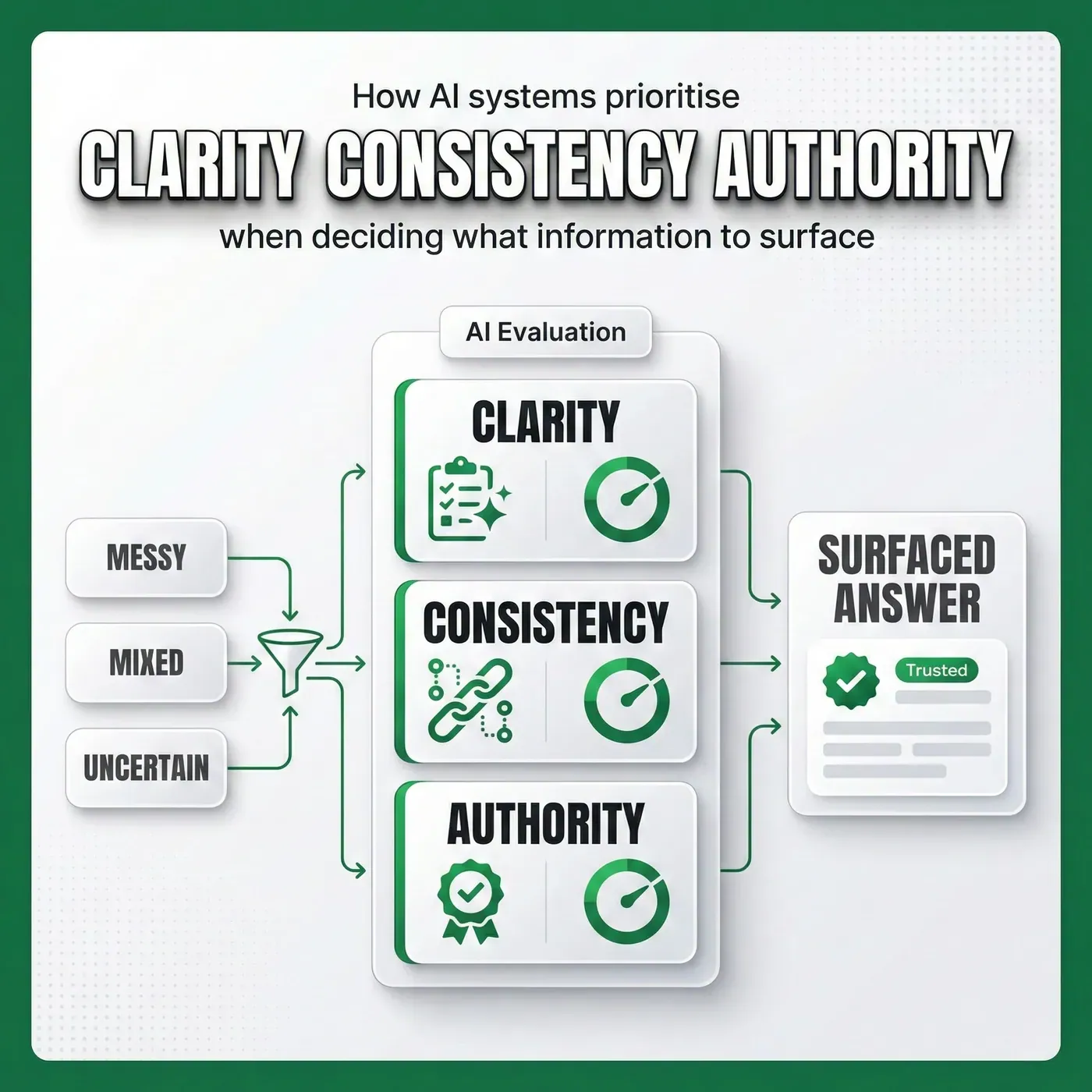
AI systems decide what content to surface by evaluating clarity, consistency, authority, and contextual relevance across multiple signals. They prioritise information that can be confidently interpreted, verified, and summarised rather than content that simply ranks well or attracts clicks.
Why this question matters now
As AI assistants increasingly sit between users and information, visibility is no longer just about ranking pages. It is about whether content can be safely compressed into an answer.
This is why many organisations see a disconnect. They rank well in search but are absent, incomplete, or distorted in AI-generated responses. That gap is not suppression. It is an interpretability problem.
AI systems surface what they can understand and trust. Everything else gets skipped.
Understanding this shift requires moving away from page-centric thinking and toward a system-level view of content.
Ranking versus surfacing
Search engines rank documents.
AI systems surface information.
That distinction changes everything.
Ranking orders pages based on relevance and authority signals. Surfacing selects facts, entities, and relationships that can be summarised without ambiguity or risk.
AI systems are not trying to find the best page. They are trying to produce the most defensible answer.
This is why AI surfacing often excludes:
- Marketing-heavy pages
- Thin or vague explanations
- Content with conflicting claims
- Persuasive copy that avoids specifics
Clarity beats optimisation in AI contexts.
The core signals AI systems rely on
While implementations vary by platform, modern AI systems tend to evaluate content using a shared set of principles.
Clarity of meaning
AI systems prioritise content that clearly explains:
- What something is
- Who it is for
- How it works
If a concept requires inference, hype translation, or assumed knowledge, it becomes harder to surface safely.
Clear definitions consistently outperform clever messaging.
Internal consistency
Contradictions are a red flag for AI systems.
If your homepage, service pages, bios, or external profiles describe you differently, the system cannot reliably summarise your entity.
Inconsistent entities are risky entities.
Brand clarity is now a visibility signal.
External corroboration
AI systems prefer information that appears consistently across independent, reputable sources.
This goes beyond traditional backlink logic and includes:
- Citations in trusted publications
- Alignment with industry standards
- Consistency with regulatory or institutional definitions
Content that exists in isolation is harder to surface than content that is reinforced elsewhere.
Structural readability
AI systems rely heavily on structure to interpret intent.
Content with:
- Clear headings
- Direct answers
- Tables or comparisons
- Explicit scope boundaries
is easier to extract, evaluate, and summarise.
This is not just for humans. It is for machines deciding what is safe to repeat.
Contextual safety
AI systems are designed to minimise harm.
Topics involving health, legal outcomes, or financial decisions require higher confidence thresholds. This aligns with long-standing guidance around sensitive or high-impact content.
Low-confidence content may still rank in search. It will not be summarised by AI.
What AI systems tend to avoid surfacing
Understanding exclusion is just as important as understanding inclusion.
AI systems commonly avoid:
- Opinion framed as fact
- Sales-led explanations
- Over-optimised keyword content
- Unclear authority claims
- Pages that mix multiple intents
This explains why some high-traffic pages disappear entirely in AI-generated responses.
Traditional SEO versus AI surfacing
Search ranking and AI surfacing operate differently.
Search focuses on pages.
AI focuses on information.
AI systems tolerate far less ambiguity, rely more heavily on structure, and penalise persuasion where explanation is required.
Authority thresholds are higher, not lower.
Why entities matter more than pages
AI systems think in entities, not URLs.
An entity can be a business, person, service, concept, or brand. Pages are just containers.
If your entity is poorly defined, AI systems struggle to place you correctly in an answer.
This is why:
- Clear about information matters
- Consistent naming matters
- Author and organisation clarity matters
Pages support entities. They do not replace them.
What this means for businesses and content teams
The shift from ranking to surfacing changes priorities.
Less emphasis on:
- Keyword density
- Page volume
- Content length for its own sake
More emphasis on:
- Precision
- Verifiability
- Cross-platform alignment
- Content designed to survive summarisation
Visibility now depends less on being loud and more on being unambiguous.
How Valpo Agency approaches AI surfacing
Valpo Agency works at the intersection of search visibility and AI interpretability, with a clear understanding of how AI decides what content to surface.
The approach focuses on:
- Designing content that explains before it persuades
- Structuring information so it can be safely summarised
- Aligning entity signals across the web
- Reducing ambiguity rather than increasing output
AI systems reward clarity, not cleverness. Strategy follows that reality.
Frequently asked questions
Can AI surface content that does not rank well in search?
Yes. AI systems are not limited to top-ranked pages if clearer or more consistent information exists elsewhere.
Does structured data guarantee AI visibility?
No. Structured data helps interpretation, but it does not override unclear, inconsistent, or unsupported content.
Is AI surfacing controllable?
Not directly. It is influenced over time through clarity, consistency, and authority.