You can generate tree service leads in winter by advertising the winter reasons people buy tree work: storm-risk reduction, dead limb hazards, clearance issues, and dormant-season pruning. Then you route that intent through high-intent channels like Google Local Services Ads and Google Search, supported by a fast, proof-heavy landing page and a follow-up system that responds in minutes. Local Services Ads are positioned by Google as pay-for-leads (not clicks) and use screening/verification badges to build trust, which fits winter’s urgency-driven searches.
Table of contents
- Why winter can outperform summer for lead quality
- What services to promote during winter
- Best ad platforms for winter tree leads
- Google Local Services Ads: winter setup and optimization
- Google Search Ads: winter campaign structure that converts
- Social media ads: when they work and when they waste money
- Landing pages and offer angles for winter conversion
- Speed-to-lead and follow-up: the hidden winter advantage
- A 14-day winter lead launch plan
- FAQs
- SEO bundle and schema
1. Why winter can outperform summer for lead quality
Winter buyers often have a stronger “reason to act” than summer buyers:
- They can see structural issues more easily when leaves are off.
- They worry about limb failure during wind, ice, or snow load.
- They want prevention before the next storm cycle.
- They want clearance work done before vehicles, roofs, and power lines become a liability.
TCIA specifically notes that with no leaves, an arborist can evaluate architecture and spot dead or diseased branches more easily, and that many skilled arborists prefer pruning when trees are dormant.
That is your winter positioning: visibility, safety, prevention, and scheduling convenience.
2. What services to promote during winter
Your winter ads should be built around winter triggers, not your full menu.
Highest-performing winter offers
- Storm-risk inspection and hazard assessment
Positioning: “Identify dangerous limbs and weak attachments before the next wind event.” - Deadwood removal and safety pruning
Positioning: “Remove hanging limbs and deadwood that could fall.” - Dormant-season pruning and structural pruning
Positioning: “Better visibility for precise pruning.” - Clearance pruning (roofline, driveway, access lanes)
Positioning: “Prevent scraping damage and improve access for winter conditions.” - Preventative removals for compromised trees
Positioning: “Remove high-risk trees before weather makes them unpredictable.”
What not to lead with
Avoid “cheap winter discount” messaging as your primary hook. It tends to attract price-only leads and weakens trust. Winter buyers are often risk-driven. Sell certainty.
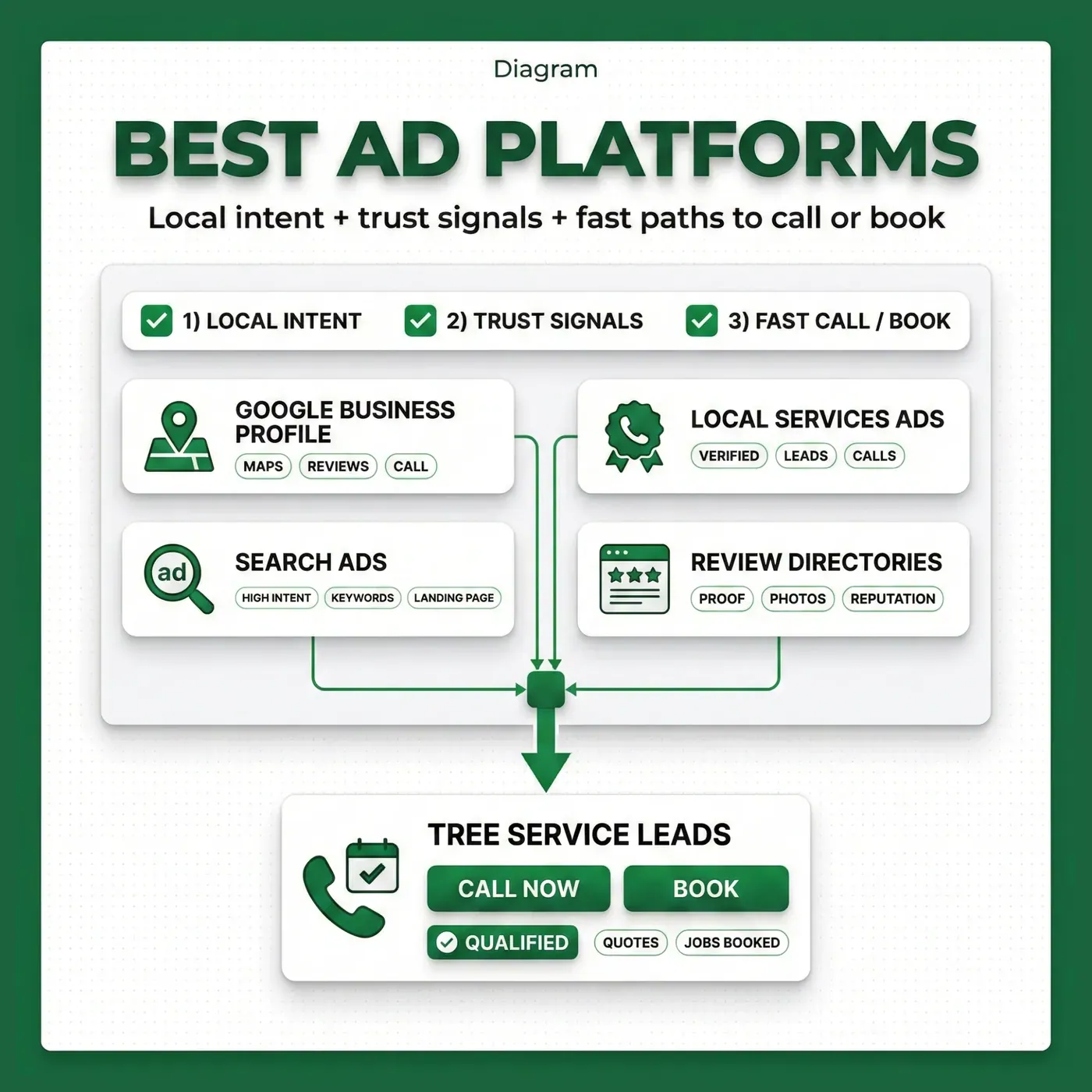
3. Best ad platforms for winter tree leads
Platform A: Google Local Services Ads (LSAs)
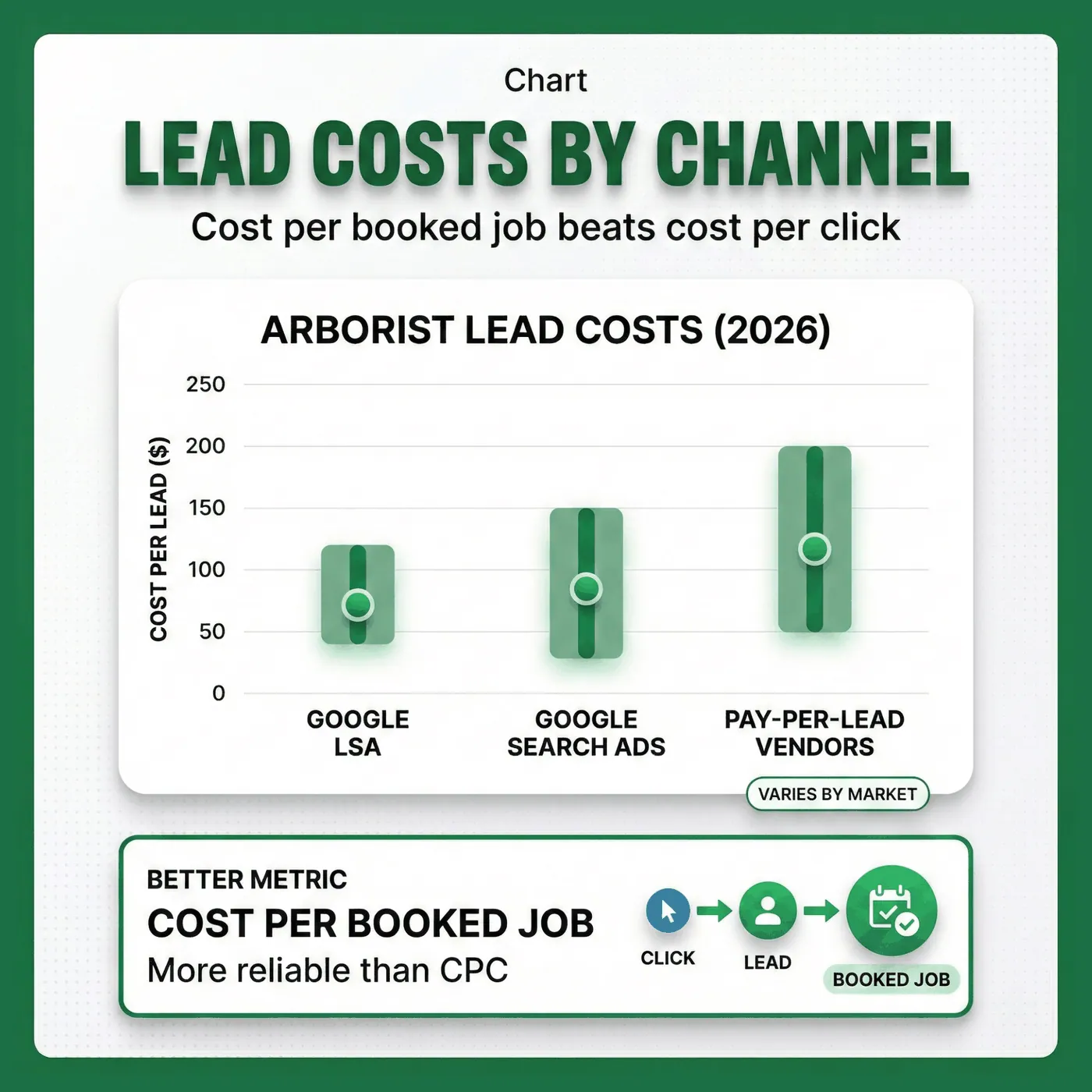
LSAs are designed to connect local customers with local providers and are positioned by Google as “pay for results, not clicks.”
Google also notes businesses must pass screening/verification and may earn Google Screened/Verified-style badges depending on category and region.
Why LSAs are strong in winter:
- winter demand spikes are urgent and call-heavy
- pay-per-lead aligns better when intent is high
- badge-based trust helps when risk perception is high
Platform B: Google Search Ads
Search ads work well in winter when you segment by intent:
- emergency terms
- “tree removal near me”
- “tree trimming” and “dead limb”
- “storm damage tree”
Search becomes expensive when you send that traffic to a generic page or miss calls.
Platform C: Paid social (Facebook/Instagram)
Social ads can work in winter, but only when you use them for:
- retargeting (people who visited your site or clicked your ads)
- seasonal awareness in a tight geo radius
- commercial targeting (property managers, facilities)
If you use social as your primary cold-lead engine, expect more tire-kickers.
4. Google Local Services Ads: winter setup and optimization
Step 1: Treat LSAs like a call center, not a billboard
LSAs punish slow response in practice because leads are competitive and urgent.
Minimum rules:
- Answer calls during business hours.
- Turn on messaging only if you can reply fast.
- Dispute truly invalid leads promptly if the platform supports it in your region.
Step 2: Pick winter service categories carefully
Do not activate every category if you cannot fulfill it quickly. Winter performance improves when:
- you advertise what you can schedule fast
- your reviews and photos match the winter intent (cleanup, safety, professionalism)
Step 3: Build trust inside the listing
Winter buyers want reassurance:
- cleanup standard
- safety approach
- “what happens next” after a call
Use your business description and photos to reinforce those.
5. Google Search Ads: winter campaign structure that converts
Structure your campaigns by winter intent
You want separate ad groups for:
- Emergency and storm damage
Ad copy: “Storm-damaged limbs removed safely. Fast response.” - Hazard and dead limb removal
Ad copy: “Remove deadwood and hanging limbs. Cleanup included.” - Dormant-season pruning
Ad copy: “Winter pruning for structure and safety. Clear quote.”
Use winter-specific landing pages
Do not send all traffic to a homepage.
A winter landing page should include:
- “winter hazard” positioning
- before/after proof
- reviews highlighting cleanliness and communication
- short estimate form plus click-to-call
Set a winter conversion goal
Track:
- calls (with call tracking)
- form submits
- booked estimate confirmations
If you only track clicks, you will optimize the wrong thing.
6. Social media ads: when they work and when they waste money
Use social for two jobs
- Retargeting
Show proof ads to people who visited your site but didn’t contact you. - Geo awareness
Short video: “Winter hazard check. Dead limbs and weak attachments are easier to spot without leaves.”
What creative converts in winter
- before/after with cleanup proof
- 10–20 second “hazard explanation” clips
- simple homeowner checklists: “3 signs your tree is a winter risk”
Avoid overly technical language. Keep it homeowner-safe and decision-focused.
7. Landing pages and offer angles for winter conversion
The five things winter buyers must see immediately
- Service area and response expectations
- Safety and property protection language
- Cleanup standard
- Proof: reviews and photos
- A simple next step: call or short form
Winter offer angles that produce higher-quality leads
- “Winter hazard inspection”
- “Dead limb removal and safety pruning”
- “Roofline and driveway clearance”
- “Storm readiness trimming”
Do not promise outcomes you cannot guarantee. You are selling assessment and safe execution.
8. Speed-to-lead and follow-up: the hidden winter advantage
Winter leads are more competitive because urgency is higher.
A simple follow-up cadence that wins:
- Immediate confirmation text (for form leads)
- Call attempt within 15 minutes
- Second attempt within 2 hours
- Next-morning follow-up
This often increases booked estimates without increasing ad spend.
9. A 14-day winter lead launch plan
Days 1–2: Build the winter offer and page
- Create a winter landing page with proof and short form.
- Add “what happens next” and response time expectations.
Days 3–5: Launch LSAs and Search
- LSAs: activate only the services you can fulfill quickly.
- Search: split campaigns into emergency, hazard/dead limb, pruning.
Days 6–7: Install tracking
- call tracking by channel
- conversion tracking for forms
- log lead source and outcome
Days 8–14: Optimize
- pause keywords that produce wrong-job leads
- shift budget to ad groups that book estimates
- improve landing page proof and clarity based on real questions callers ask
FAQs
What’s the best winter advertising message for tree services?
Safety and prevention: dead limbs, storm risk, and dormant-season evaluation and pruning are strong hooks.
Are Google Local Services Ads worth it in winter?
Often yes, because winter searches are urgent and call-heavy, and Google positions LSAs as pay-per-lead with screening/verification trust signals.
Should I run discounts in winter?
Not as your main offer. Lead with risk reduction and professionalism. Discounts tend to lower lead quality.
What makes winter ads fail?
Generic messaging, sending traffic to a generic page, missed calls, slow follow-up, and no proof of cleanup and safety.