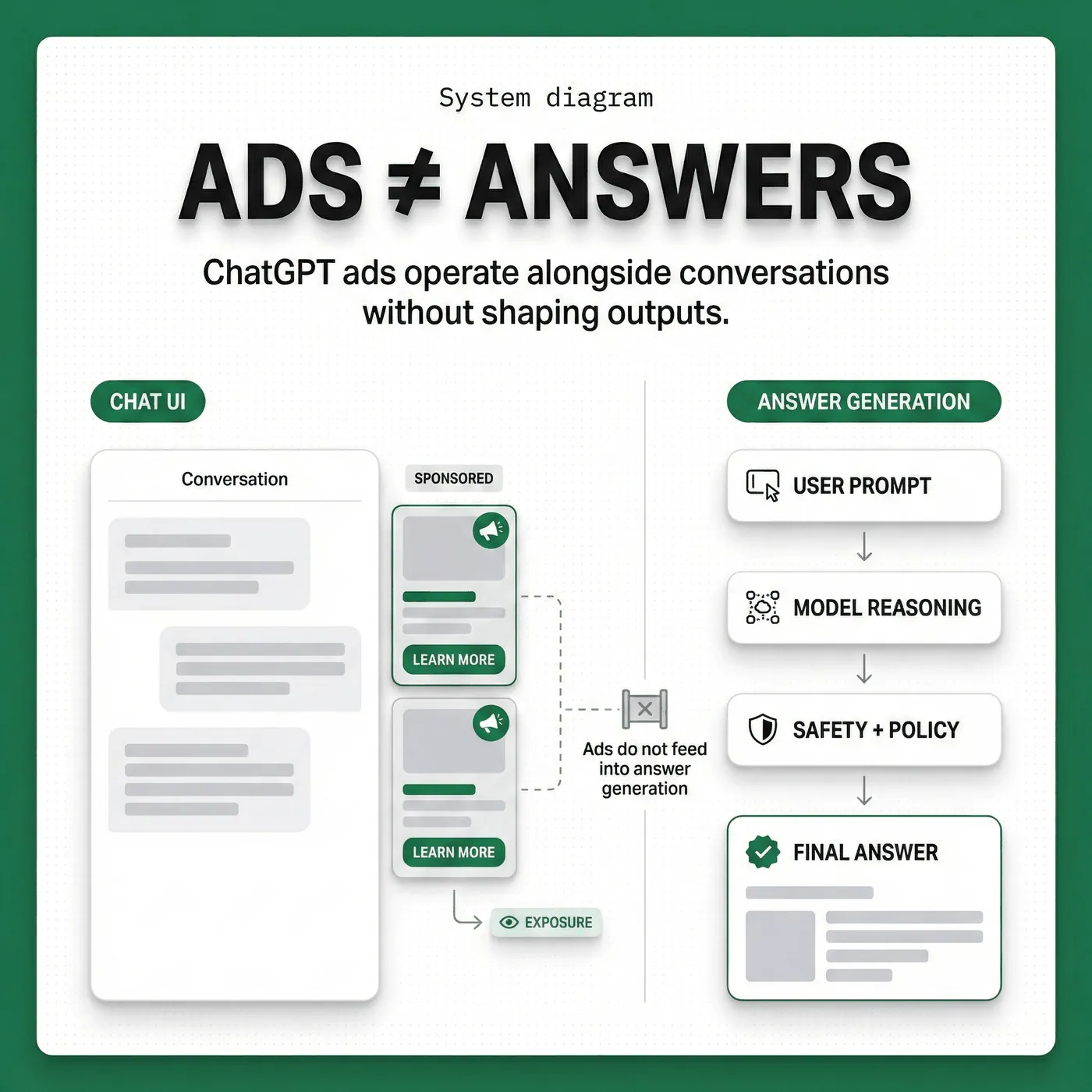
ChatGPT ads do not influence how AI-generated answers are created. OpenAI has explicitly stated that advertising is structurally separated from response generation, with safeguards in place to prevent paid placement from shaping outputs, conclusions, or factual framing.
Why this question keeps coming up
Any time a platform introduces advertising, people assume influence follows. That assumption makes sense historically.
In search engines, paid placements affect visibility.
In social feeds, sponsored content blends into organic posts.
In marketplaces, promoted listings crowd out unpaid ones.
AI systems break that pattern, but users still apply the same mental model. The question “Do ChatGPT ads influence AI answers?” exists because search-era logic is being applied to a generative system.
That mismatch is where most confusion starts.
To answer the question correctly, you have to understand where ads sit relative to how ChatGPT actually produces responses.
How ChatGPT generates answers
ChatGPT does not rank web pages or select top results. It generates responses by predicting likely next tokens based on several layers working together:
- Model training
- Retrieval or reference systems when applicable
- Safety and policy enforcement
- Prompt context
Advertising is not part of this pipeline.
OpenAI documentation confirms that ads are not used as training data, are not injected into prompts, and are not allowed to bias outputs. This separation is architectural, not cosmetic.
OpenAI’s stated position on ad influence
OpenAI has made its position clear through documentation and public reporting:
- Ads do not alter responses
- Ads are clearly labelled and visually separate
- User conversations are not sold or reused for ad targeting
Reporting from Reuters confirms that ads appear alongside conversations, not within them, and that paid tiers remain ad-free to preserve trust and professional use cases.
This design choice is intentional. If ads influenced answers, the core product would lose credibility.
Why influencing answers would break the system
Allowing ads to shape AI answers would create immediate and serious problems.
Legal and regulatory exposure
AI systems increasingly operate in regulated environments. Paid influence over answers would raise major concerns around deceptive practices, especially in health, legal, and financial contexts. This is why sensitive categories are excluded from ad placement entirely.
Loss of product trust
ChatGPT’s value is synthesis and explanation, not discovery. Once users believe answers are bought, trust collapses. Unlike search, where commercial bias is expected, generative AI depends on perceived neutrality.
Model integrity issues
Injecting paid signals into generation would contaminate evaluation loops, making it harder to measure bias, safety, and quality. OpenAI has strong incentives to avoid this.
What ChatGPT ads can influence indirectly
This is where nuance matters.
What ads can influence
Brand familiarity
User-level recall
Downstream engagement with external content
If an ad increases awareness, and that awareness leads users to content that becomes widely cited elsewhere, AI systems may later reference that entity organically. This is a multi-step, indirect effect.
What ads cannot influence
Which sources are considered authoritative
How facts are weighed
The tone or conclusion of an answer
Jurisdictional or technical accuracy
There is no technical or policy-based evidence that ChatGPT ads override authority signals.
Ads versus answer generation
Paid exposure and AI answers operate as parallel systems.
Ads scale with spend.
Answers scale with verification and structure.
Advertising can increase visibility around the interface. It does not buy inclusion inside the response.
Why many businesses are misreading this
A common assumption is:
“If ChatGPT has ads, we need to advertise to be visible.”
This mirrors early misunderstandings of search engines, where ads were confused with relevance. In AI systems, visibility is built first. Monetisation follows. Ads are optional. Authority is not.
How Valpo Agency approaches ChatGPT ads
Valpo Agency treats ChatGPT ads as a contextual layer, not a visibility strategy.
The focus remains on:
Structuring content so AI systems can reliably interpret it
Maintaining consistent entity data across the web
Building citation-ready information architectures
Separating paid exposure from long-term authority
This prevents businesses from over-investing in placements that do not compound trust.
The principle is straightforward.
Ads can increase awareness. Answers are earned.
Frequently asked questions
Can advertisers pay to appear in ChatGPT answers?
No. There is no mechanism for inserting or influencing AI-generated responses through advertising.
Is OpenAI likely to change this?
There is no public indication that ads will be blended into responses. Doing so would conflict with stated safeguards and trust goals.
Should businesses ignore ChatGPT ads completely?
Not necessarily. Ads may have branding value, but they should not be mistaken for authority, citation, or answer visibility.