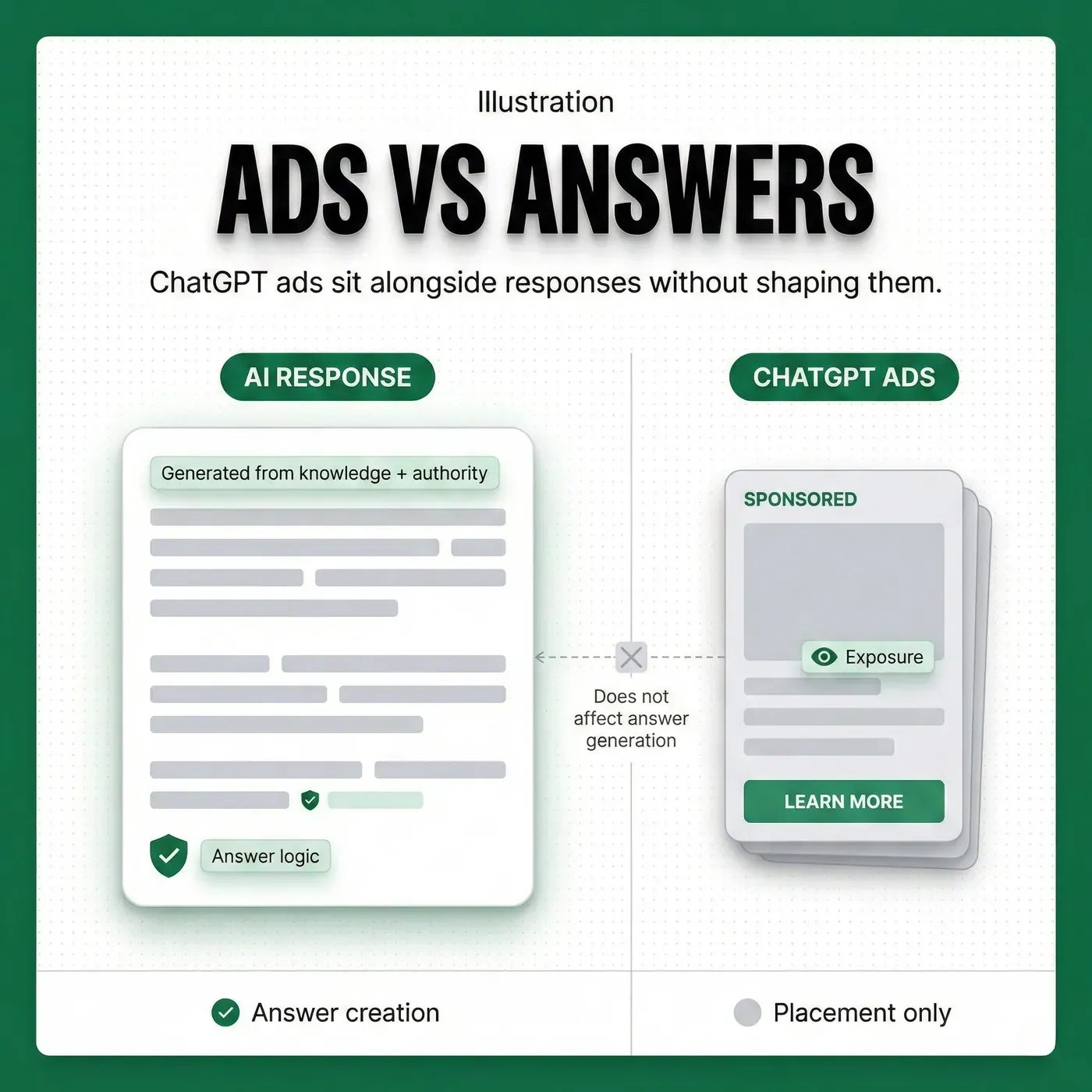
ChatGPT ads are a confirmed advertising feature that OpenAI plans to introduce for free and lower-tier users. These ads are designed to be clearly separated from AI-generated responses and do not influence how answers are written, ranked, or selected.
This distinction is critical and widely misunderstood.
What ChatGPT ads actually are
ChatGPT ads represent a monetisation change, not a change in how the AI functions.
OpenAI has confirmed that ads will be rolled out gradually, starting with limited testing for free and lower-cost plans. Paid tiers remain ad-free. Ads will be clearly labelled, visually distinct, and positioned outside the conversational response itself.
That means ChatGPT ads are not:
- Sponsored answers
- Paid rankings
- Keyword bidding inside responses
They function more like contextual or display placements than search ads.
OpenAI has also made several firm commitments:
- Ads do not influence response generation
- Conversation data is not sold to advertisers
- Sensitive topics such as health, mental health, and politics are excluded
This places ChatGPT ads in a different category than traditional search advertising models.
Why OpenAI is introducing ads now
For years, OpenAI resisted advertising. That position shifted as usage scaled and operational costs increased.
Three forces explain the timing.
Compute costs at scale
Running large language models is expensive. Free usage grows faster than subscription revenue, even with strong paid adoption. Advertising adds a revenue layer without forcing casual users behind paywalls.
Competitive alignment
AI platforms are converging with search, productivity, and discovery tools. Monetisation across the industry is diversifying, and OpenAI is aligning with broader platform economics rather than remaining an exception.
Clearer user segmentation
OpenAI now has defined user tiers:
- Free users
- Entry-level paid users
- Professional and enterprise users
Ads are limited to tiers where expectations and tolerance differ, protecting trust among professional users.
Where ChatGPT ads will appear
Based on OpenAI disclosures and reporting from Reuters, AP News, and The Guardian:
- Ads appear outside AI-generated responses
- Ads are clearly labelled
- Ads do not interrupt answers mid-sentence
- Ads are not personalised using chat history
This design choice protects the integrity of the response itself. Ads sit next to the conversation, not inside the reasoning.
How ChatGPT ads differ from Google Search ads
This is where confusion usually starts.
Google Search ads:
- Triggered by keywords
- Integrated into result pages
- Compete with organic listings
- Directly affect visibility
ChatGPT ads:
- Not keyword auctions
- Not ranking replacements
- Not answer modifiers
- Not transactional by default
ChatGPT does not operate on a ranked results page. It generates responses based on probabilistic reasoning and retrieval systems. Ads exist around that process, not within it.
Applying SEO or PPC mental models to ChatGPT ads leads to bad decisions.
What ChatGPT ads do not change
This is the most important takeaway for businesses.
ChatGPT ads do not change:
- How accuracy is evaluated
- How authority is determined
- How entities are referenced
- How local relevance is inferred
- How structured information is prioritised
AI systems still rely on:
- Verifiable sources
- Consistent entity data
- Structured content
- Clear topical authority
Advertising does not replace these signals.
What ChatGPT ads might influence indirectly
There are limited secondary effects worth understanding.
Brand familiarity
Repeated exposure may increase brand recognition. Over time, that familiarity can influence user trust when an entity appears organically. This is indirect and not guaranteed.
Downstream content effects
If ads drive traffic to content that becomes widely cited, referenced, or discussed elsewhere, that content may later influence AI systems indirectly. This is a second-order effect, not a direct ranking factor.
Ads versus authority signals
Paid placement and AI visibility operate as parallel systems.
Ads scale with spend.
Authority scales with verification.
Ads can increase exposure. Authority determines whether an AI system trusts and references an entity.
Why many businesses are misreading this shift
A common assumption is:
“If ChatGPT has ads, we need to advertise to be visible.”
That mirrors early misunderstandings of search engines, where ads were confused with relevance.
In AI systems, visibility is built before monetisation, not after. Ads are optional. Authority is not.
How Valpo Agency approaches ChatGPT ads
Valpo Agency treats ChatGPT ads as a contextual layer, not a growth lever.
The focus remains on:
- Structuring content for AI interpretation
- Maintaining entity consistency across the web
- Building citation-ready information architectures
- Separating paid exposure from long-term visibility
This prevents short-term placement from undermining durable trust.
The principle is simple.
Ads can amplify awareness. Structure earns trust.
Frequently asked questions
Are ChatGPT ads live now
No. Ads are planned and entering limited testing phases, primarily in the United States.
Do ChatGPT ads affect how answers are written
No. OpenAI has confirmed ads do not influence response generation.
Will businesses be able to bid on keywords
There is no indication that ChatGPT ads will operate on a keyword bidding model.